
| Secretariat, Alumni Association, IDAC | |
| Date | Wednesday, 19 February 2020,16:30~ |
|---|---|
| Room | 7th Floor, Seminar Room 1, IDAC Center for Basic Aging Research |
| Title | Recent insight into maintenance of chromosome stability through functional analyses of ICF syndrome causative genes |
| Speaker | Motoko UNOKI |
| Affiliation | Medical Institute of Bioregulation, Kyushu University |
| Organizer | Ayako Ui (Department of Molecular Oncology・ext 8469) |
| Abstract | ICF syndrome is a rare autosomal recessive disease characterized by immunodeficiency, chromosomal instability, and facial anomalies. About half of the patients show hypomethylation of centromeric and pericentromeric repeats (the other half show hypomethylation only of pericentromeric repeats). We identified CDCA7 and HELLS, which compose a chromatin remodeling complex, as causative genes of the syndrome by exome analysis. Subsequent functional analyses revealed that these proteins are involved in non-homologous end joining (NHEJ) by facilitating Ku80 recruitment to DNA damage sites. Currently, we are trying to further deepen an insight into pathogenesis of the syndrome. In this seminar, I would like to present the latest results and discuss a possible mechanism of maintenance of chromosome |
Author: superuser_1
IDAC Seminar: February, 18 2020
| Secretariat, Alumni Association, IDAC | |
| Date | Tuesday, 18 February 2020, 17:00-18:30 |
|---|---|
| Room | 7th Floor, Seminar Room 1, IDAC Center for Basic Aging Research |
| Title | Lesson from ex vivo bioengineering platelet pharming. |
| Speaker | Koji Eto |
| Affiliation | CiRA, Kyoto University and Chiba University School of Medicine |
| Organizer | Hozumi Motohashi, Dept. of Gene Expression Regulation・ext 8550 |
| Abstract | To generate the huge number of platelets required for thrombocytopenia patients (200-300 billion per transfusion) ex vivo, megakaryopoiesis and thrombopoiesis must be both considered for substantial improvement. For the former, our key measure is to expand the immortalized megakaryocyte cell lines (imMKCLs) derived from pluripotent stem cells, embryonic stem cells or induced pluripotent stem cells (iPSCs) (Cell Stem Cell, 2014). For the latter, there have been an idea of bioreactors where shedding of platelets is promoted by flow-dependent shear stress as previously observed in bone marrow studies (Science, 2007; J Exp Med, 2015; etc.), but there have been no satisfactory prototype using flow-chamber system based alone on shear stress. We have recently found turbulent flow is critically involved in platelet shedding from mouse bone marrow megakaryocytes in vivo, thereby to develop a novel bioreactor system for ex vivo platelet generation. The bioreactor system, VerMES in 8L scale, achieved 100 billion-order platelet generation with intact function including normal hemostasis capability in mouse and rabbit models with thrombocytopenia (Cell, 2018). Meanwhile, we have recently recognized that remodeling of imMKCL megakaryocytes is required for intact/healthy platelet generation ex vivo, which could be regulated by such turbulent energy (Cell, 2018 and unpublished results). Question is what is sensing of “turbulent energy” in imMKCL/bioreactor system? Here we show that unique sensing system in imMKCL plays important roles, whereby HDAC6 and related signaling pathways regulate sensing machinery and downstream change of membrane structure of imMKCL towards platelet shedding. |
IDAC Seminar: February, 7 2020
| Secretariat, Alumni Association, IDAC | |
| Date | Friday, 7 February 2020, 17:00~18:30 |
|---|---|
| Room | 7th Floor, Seminar Room 1, IDAC Center for Basic Aging Research |
| Title | Understanding and Control of Life Phenomena by Mathematical Modeling |
| Speaker | Teppei Shimamura |
| Affiliation | Nagoya University Graduate School of Medicine |
| Organizer | Hozumi Motohashi, Dept. of Gene Expression Regulation・ext 8550 |
153rd IDAC Bi-Annual Meeting

IDAC’s 153rd Biannual Meeting (an all-English event), will take place on January 31st from 1PM at the Center for Smart-Aging Research Building, 1st Floor.
For more details, please click to see the poster.
IDAC Seminar: January 29, 2020
| Secretariat, Alumni Association, IDAC | |
| Date | Wednesday, 29 January 2020, 13:30-14:30 |
|---|---|
| Room | 7th Floor, Seminar Room 1, IDAC Center for Basic Aging Research |
| Title | Increasing resilience with a balanced neuron‐astrocyte interaction. |
| Speaker | Mia Lindskog |
| Affiliation | Karolinska Institutet |
| Organizer | Hozumi Motohashi, Dept. of Gene Expression Regulation・ext 8550 |
| Abstract | The ability of the brain to adapt to new environmental challenges is a key factor to resilience and thus to stay mentally healthy during aging. Brain plasticity is thus one of the most critical aspects of brain function and there is a plethora of mechanisms, from molecular to brain area level, that conveys functional plasticity. Decreased plasticity is seen in many different brain disorders and associated with cognitive decline whereas increasing plasticity, can be a way to increase resilience to brain disorders. Astrocytes, the most common non-neuronal cells in the brain, are well known to be critical in keeping the brain homeostasis, but it is becoming increasing clear that astrocytes also regulate neuronal signalling and plasticity. We are focusing on how the astrocyte and neuron interaction mediate brain plasticity. In particular, we are focusing in the interaction between astrocytes and glutamatergic synapses through uptake of glutamate and release of gliotransmittors. |
IDAC Seminar: January 22, 2020
| Secretariat, Alumni Association, IDAC | |
| Date | Wednesday, 22 January 2020, 16:00 |
|---|---|
| Room | Center for Smart Aging Research 1F, IDAC |
| Title | Dimensional Deconstruction of Neuropsychiatric Disorders Associated with 22q11.2 Copy Number Variation |
| Speaker | Professor Noboru Hiroi |
| Affiliation | University of Texas Health Science Center at San Antonio |
| Organizer | Ryuta Kawashima (Dept. of Functional Brain Imaging) |
| Contact | Rie Ryoke (Dept. of Functional Brain Imaging・ext 8492) |
IDAC Seminar: January 16, 2020
| Secretariat, Alumni Association, IDAC | |
| Date | Thursday, 16 January 2020, 16:00~ |
|---|---|
| Room | Seminar Room,Center for Smart Aging Research 2F, IDAC |
| Title | At the root of bodily self-consciousness. |
| Speaker | Lorenzo Pia, Associate Professor |
| Affiliation | Department of Psychology, University of Turin (Italy) |
| Organizer | Dalila Burin (Smart Ageing International Research Center・ext 8585) |
| Abstract | Human self-awareness is rooted on the feeling that the physical body belongs to us (body ownership) and that we intend and control its movements (sense of agency). How those two neurocognitive mechanisms interact and whether they share some common mechanism are still open questions. By means of behavior, physiology (e.g., EEG, TMS) and Immersive Virtual Reality, I will try to address this problem. I will start investigating the possible link between the two senses with a correlation approach. Then, I will discuss studies focused on how body ownership affects sense of agency. Thirdly, I will present data around the opposite interaction (i.e., how sense of agency might affect body ownership). At the end, I will attempt to provide a unique frame of reference for ownership and agency able to explain the coherence and the unity of bodily self-consciousness. |
IDAC Seminar: January 14, 2020
| Secretariat, Alumni Association, IDAC | |
| Date | Tuesday, 14 January 2020, 14:00 onwards |
|---|---|
| Room | Medium-size Conference Room, IDAC Center for Clinical Aging Research 1F |
| Title | Impact of medical physics in personalized care for heart disease patients. |
| Speaker | Dr. Andrew Narracott |
| Affiliation | The University of Sheffield |
| Organizer | Tomoyuki Yambe (Pre-Clinical Research Center) |
| Contact | Yasuyuki Shiraishi (Pre-Clinical Research Center・ext 8517) |
| Abstract | In order to deliver innovative technologies to support improved medical device design and patient diagnosis and treatment in the field of personalized cardiovascular medicine, the interdisciplinary approaches are carried out. In the seminar, recent network collaboration with the academic focus that could exploit clusters of medical physics and fluid dynamics based on biomedical research activities in the field of cardiovascular disease are introduced. |
IDAC Seminar: January 6, 2020
| Secretariat, Alumni Association, IDAC | |
| Date | Monday, 6 January 2020, 15:00 to 16:00 |
|---|---|
| Room | Seminar Room, Center for Smart Ageing Research 4F, IDAC |
| Title | A Progress of AD study using MR-phase information and its perspectives. |
| Speaker | Tetsuya YONEDA |
| Affiliation | Department of Medical Imaging Sciences, Faculty of Life Sciences, Kumamoto University |
| Organizer | Yasuyuki Taki (Dept. of Nuclear Medicine and Radiology) |
| Contact | Yasuko Tatewaki (Dept. of Nuclear Medicine and Radiology・ext 8559) |
| Abstract | MRI-phase information is known as a tool to detect amyloid plaque (AP) in the brain. Our collaborative researches revealed that the phase information of AP linked to MMSE. The derivation of AP information via phase, however, needed non-linear gaussian fits, and its detection power depended upon individual performance of operators. In this seminar, we will suggest a simplified and objective method to detect AP, and talk about a future direction of our study. |
IDAC Seminar: November 21, 2019
| Secretariat, Alumni Association, IDAC | |
| Date | Thursday, 21 November 2019, 16:00 to 17:30 |
|---|---|
| Room | 7th Floor, Seminar Room 1 & 2, IDAC Center for Basic Aging Research |
| Title | New trends in external cooperation: Digitalization of academic-industrial collaboration. |
| Speaker | 1, Ryosuke Shibato 2, Takaya Matsumoto 3, Takao Kunii |
| Affiliation | 1, Academist,Inc. 2, InnerResource.Inc 3, Linkers Corporation |
| Organizer | Kozo Tanaka (Department of Molecular Oncology・ext 8491) |
IDAC Seminar: November 11, 2019
| Secretariat, Alumni Association, IDAC | |
| Date | Monday, 11 November 2019, 17:00~ |
|---|---|
| Room | Medium-size Conference Room, IDAC Center for Clinical Aging Research 1F |
| Title | A data-driven approach for personalized breast cancer care. |
| Speaker | Hideyuki Shimizu |
| Affiliation | Department of Molecular and Cellular Biology, Medical Institute of Bioregulation, Kyushu University, |
| Organizer | Koyu Ito (Dept. Immunobiology・ext 8579) |
IDAC Seminar: October 29, 2019
| Secretariat, Alumni Association, IDAC | |
| Date | Tuesday, 29 October 2019, 17:00 onwards |
|---|---|
| Room | 7th Floor, Seminar Room 1, IDAC Center for Basic Aging Research |
| Title | Perspective on HLA genome and gene analysis by NGS |
| Speaker | Takashi Shiina |
| Affiliation | Department of Molecular Life Science, Division of Basic Medical Science and Molecular Medicine, Tokai University School of Medicine |
| Organizer | Koetsu Ogasawara (Dept. Immunobiology・ext 8579) |
| Abstract | The highly polymorphic Human Leukocyte Antigen (HLA) molecules (alleles) expressed by the different classical HLA class I and class II genes have crucial roles in the regulation of innate and adaptive immune responses. To date, over 23,000 HLA alleles have been published from IPD-IMGT/HLA database, and specific HLA alleles and HLA haplotypes have been reported to be associated with graft-versus-host disease (GVHD) of hematopoietic stem cell transplants, the pathogenesis of numerous infectious and/or autoimmune diseases and allergic reactions to various drugs. However, the HLA polymorphisms and HLA gene expression profiles have yet to be fully defined and understood in the processes of inflammatory and immune responses and autoimmune, chronic and infectious diseases. In recent years, various innovative techniques using next generation sequencer (NGS) have been developed for high-resolution level polymorphism and gene expression analyses of HLA genes, and they are expected to become a breakthrough for comprehensive understanding of the innate and acquired genetic factors of disease pathogenesis. In this seminar, I would like to introduce our developed NGS based HLA analysis methods and characteristics of DNA polymorphisms and RNA expression levels in Japanese population. |
IDAC Seminar: October 25, 2019
| Secretariat, Alumni Association, IDAC | |
| Date | Friday, 25 October 2019, 17:00 to 18:30 |
|---|---|
| Room | 7th Floor, Seminar Room 1, IDAC Center for Basic Aging Research |
| Title | High-resolution Analysis of Transcribed Enhancers Using a Novel 5’ Nascent RNA Sequencing |
| Speaker | Yasuhiro Murakawa |
| Affiliation | RIKEN Center for Integrative Medical Sciences |
| Organizer | Hozumi Motohashi (Dept. Gene Expression Regulation・ext 8550) |
| Abstract | Enhancers are activated in a highly cell-type specific manner, and play key roles in generating cell-type-specific transcriptomes. Capped transcripts are generated bi-directionally from active enhancers, but these transcripts are actively degraded by the nuclear exosome complex immediately after their synthesis. Here we developed a simple and robust NET-CAGE technology to profile 5’-ends of nascent RNAs in diverse cells and tissues, and we studied RNA synthesis and degradation at the transcription start site level. Sensitive and high-resolution analysis of enhancer-derived RNAs without the influence of RNA degradation allowed us to identify a number of new enhancers at an unprecedented depth, and to delineate primary locations of transcription within super-enhancers. I will talk about new insights into the dynamic and topological interplay between cis-regulatory elements. |
| Reference | Hirabayashi S., Bhagat S., Matsuki Y., Takegami Y., Uehata T., Kanemaru A., Itoh M., Shirakawa K., Takaori-Kondo A., Takeuchi O., Carninci P., Katayama S., Hayashizaki Y., Kere J., Kawaji H., Murakawa Y. NET-CAGE Characterizes Dynamics and Topology of Human Transcribed Cis-regulatory Elements. Nature Genetics, 51(9):1369-1379 (2019) |
IDAC Seminar: October 11, 2019
| Secretariat, Alumni Association, IDAC | |
| Date | Friday, 11 October 2019, 10:00 to 11:00 |
|---|---|
| Room | 6F Seminar Room, Center for Smart Aging Research, IDAC |
| Title | Effects of uncertainty on curiosity in young and older adults. |
| Speaker | Yagi Ayano |
| Affiliation | Research Institute of KUT, Kochi University of Technology |
| Organizer | Nouchi Rui (Department of Cognitive Health Science・ext 8952) |
2019 Joint Research Center Seminar: October 2 (Wednesday), 2019
| Information for the 2019 Joint Research Center Seminar | |
| Date | Wednesday, 2 October 2019, 17:00~18:30 |
|---|---|
| Room | 1st Floor, International Conference Room, Center for Smart-Aging Research, IDAC |
| Title | Macrophage production and functions in inflammatory diseases and regulated by TRIM33. |
| Speaker | Professor Paul-Henri Romeo (CEA, France) |
| Affiliation | The French Alternative Energies and Atomic Energy Commission (CEA) |
| Abstract | Macrophages are regulators of both tissue homeostasis and acquired diseases such as cancer, inflammatory diseases and bacterial and viral infections. The macrophage specific transcriptional programs are dictated by the transcription factor PU.1 that primes distal regulatory elements for macrophage identities and makes chromatin competent for activity of stimuli-dependent transcription factors. Although the functions of macrophage-specific distal regulatory elements that bind PU.1 have been elucidated, the underlying mechanisms of action of these cis-acting sequences are not characterized. The tripartite motif (TRIM) family of proteins plays important roles in innate immunity and antimicrobial infection but none of these proteins has been shown to directly regulate transcription of genes in macrophage. We will show that TRIM33 is recruited by PU.1 in a subset of macrophage specific regulatory sequences of genes involved in the inflammatory response and that sequestering of SPT16/FACT by TRIM33 at PU.1-bound distal regions might represent a new regulatory mechanism for RNA Pol II recruitment and transcription output in macrophages. Functionally, we will show that expression of TRIM33 in immature myeloid cells is necessary for efficient production of small peritoneal macrophages and bone marrow derived macrophage, that TRIM33 regulates macrophage function during inflammatory diseases such as Crohn’s disease and a previously unknown mechanism of macrophage-specific regulation of Ifnb1 transcription whereby TRIM33 is critical for Ifnb1 gene transcription shut down. |
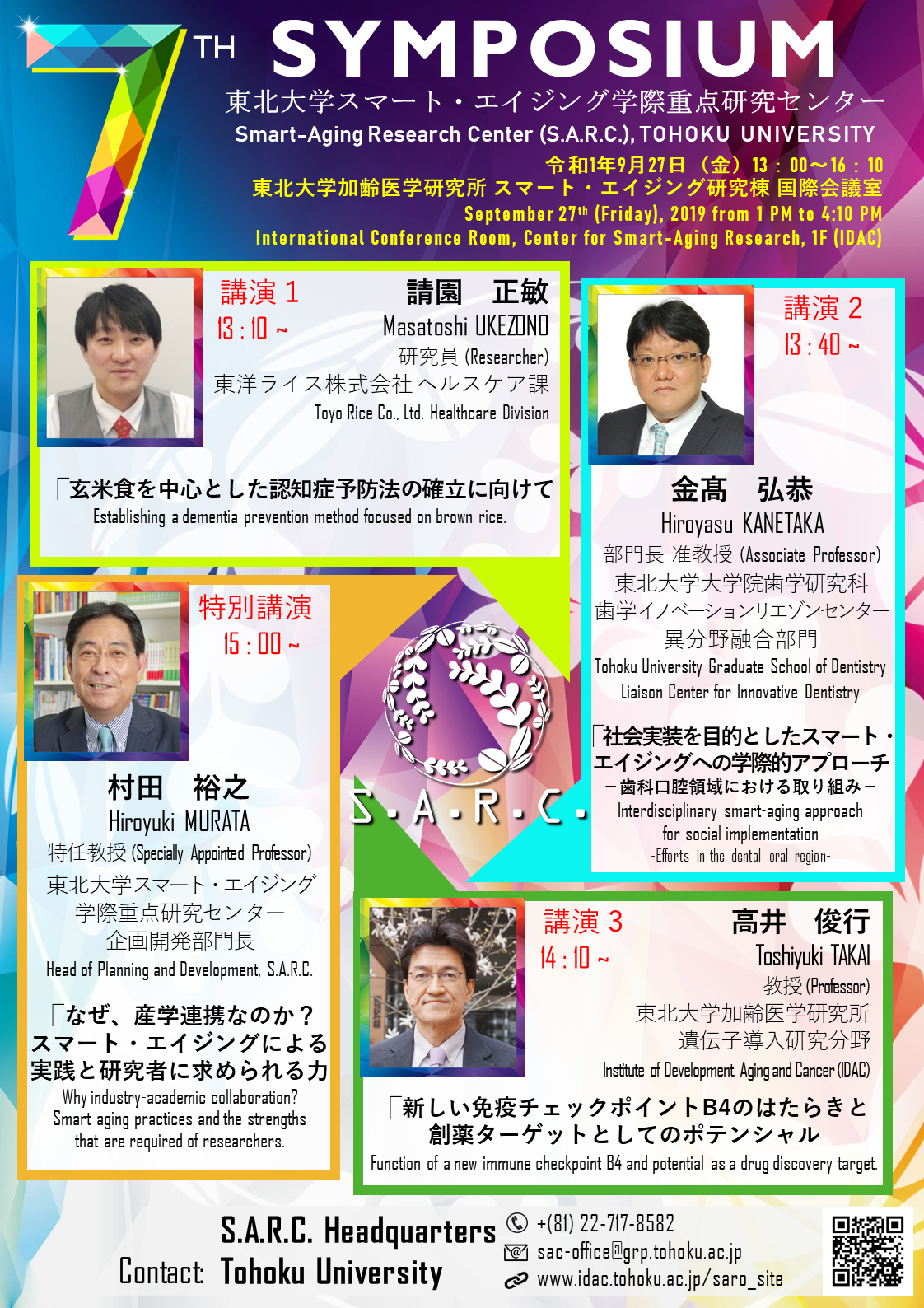
SARC’s 7th Symposium on Dementia Prevention 2019

S.A.R.C.’s 7th Symposium on Dementia Prevention will be held at IDAC on September 27, (Friday), from 1:00 PM – 4:10 PM at the Smart-Aging International Conference Room.
Tohoku University’s Smart-Aging Research Center (S.A.R.C.) was established in 2017 to focus on promoting research that is aimed at realizing healthy longevity by conducting research for the prevention and treatment of age-related diseases such as dementia using a multi-tier approach from basic research to medical, ergonomics and social science. Furthermore, S.A.R.C. conducts interdisciplinary activities not only in basic research, but also in social implementation through industry-academic collaborations and ventures.
In this symposium, four lectures will take place from up and coming researchers that are actively involved in basic research from various life science fields, both locally and globally, with a focus on providing practical applications for a better and healthier society.
To visit S.A.R.C.’s homepage, click on: S.A.R.C.
For more details on S.A.R.C.’s 7th Symposium, please see the poster below:
IDAC Seminar: September 11, 2019
| Secretariat, Alumni Association, IDAC | |
| Date | Wednesday, 11 September 2019, 11:00~13:00 |
|---|---|
| Room | 7th Floor, Seminar Room 1, IDAC Center for Basic Aging Research |
| Title | 1. NOS2 and COX2 as major drivers of poor outcome in ER- breast cancer. New therapeutic opportunities in a difficult disease. 2. Reactive Species Interactions and the ‘Redox Interactome’ Lessons from a Journey in Adaptations to Stress |
| Speaker | 1. 11:00-12:00 David A. Wink 2. 12:00-13:00 Martin Feelisch |
| Affiliation | 1. Cancer and Inflammation Program, Center for Cancer Research, National Cancer Institute, National Institutes of Health 2. Clinical & Experimental Sciences, Faculty of Medicine, Southampton General Hospital and Institute for Life Sciences, University of Southampton1. |
| Organizer | Hozumi Motohashi (Dept. Gene Expression Regulation・ext 8550) |
| Abstract | 1. Pro-inflammatory signaling pathways are commonly up-regulated in breast cancer. In estrogen receptor-negative (ER-) and triple-negative breast cancer (TNBC), nitric oxide synthase-2 (NOS2) and cyclooxygenase-2 (COX2; PTGS2) are independent predictors of disease outcome. To investigate the effect of their co-expression on breast cancer survival, we analyzed tumors from 248 patients and found that their combined expression is associated with a dismal survival of ER- patients with less than 50% of them surviving 5 years post diagnosis. Furthermore, we found that the key metabolites of NOS2 and COX2, nitric oxide (NO) and prostaglandin E2 (PGE2), are drivers of the co-expression when we analyzed the NOS2-COX2-crosstalk in MDA-MB-468 (basal-like) and MDA-MB-231 (mesenchymal-like) TNBC cell lines. We identified a feed-forward relationship where NO induces COX2 and PGE2 induces NOS2. Induction of COX2 was dependent on the NO-mediated activation of TRAF2 which occurred in a TNFα-dependent manner in MB-468 cells. In contrast, TRAF2 activation involved the endoplasmatic reticulum stress response in MDA-MB-231 cells. Moreover, simultaneous inhibition of NOS2 and COX2 using aminoguanidine (AG) and aspirin yielded an additive reduction in growth of MDA-MB-231 tumor xenografts. Pathway analysis of patients that compared NOS2hi/COX2hi (25% survival) and NOS2lo/COX2lo (100% survival) patients revealed that pathways associated with IFNγ and IL-17. In vitro studies show that IFNγ in conjunction with IL17A/F but not IL17A/F alone dramatically increase NOS2/COX2 expression. Furthermore, IFNγ increased immunosuppressive markers PDL1 and IDO1 as well as ICAM-1 associated with metastasis in NO/PGE2 independent manner. These levels IFNγ required to activate these NOS2/COX dependent and independent pathways were considerably lower than those associated with therapeutic levels of IFNγ associated with antitumor immune response. Taken together, these results suggest that pathways associated with IFNγ play a role in NOS2/COX2 expression leading to a feed-forward interaction activating many critical oncogenic pathways that have been associated with the progression of ER- breast cancer and offers insight into the mechanism that causes poor survival of these patients. 2. One in four of us will require Critical Care at some stage of their life; of those admitted to the Intensive Care Unit of a hospital on average 40% will die. Important and costly patient management decisions are often based on very limited ‘hard data’, with little information on bodily function other than acute organ damage as well as cardiovascular/respiratory, renal/electrolyte and oxygenation status. Cellular hypoxia, with systemic inflammation, is a near ubiquitous challenge in this setting, and supplementary oxygen is given almost indiscriminately to treat lower arterial pO2. These conditions are associated with marked alterations in redox signalling but little is known that would be useful to guide treatment decisions, and research efforts are often limited by ethical considerations. An alternative approach is to study healthy individuals subjected to similar stresses in a more controlled fashion. This seminar will provide an overview of experimental insights gained from whole-body investigations at high altitude where hypoxia-related metabolic perturbations such as oxidative stress and inflammation are an inevitable feature. I will review some of the complexity of the molecular interactions of reactive oxygen, nitrogen and sulfur species with each other and their biological targets in the context of whole-body regulation in health and discuss how this may be altered in disease states and used to inform future treatment of the critically ill patient. |
IDAC Seminar: August 30, 2019
| Secretariat, Alumni Association, IDAC | |
| Date | Friday, 30 August 2019, 13:30 to 15:00 |
|---|---|
| Room | 2F Seminar Room, Center for Smart Aging Research, IDAC |
| Title | Cross-sectional and longitudinal factors affecting cognitive function in older adults: a pan European cohort study based on the survey of health, ageing and retirement in Europe (SHARE) |
| Speaker | Raquel Cervigón Abad |
| Affiliation | Department of Electronics, Electrical, Automatics and Communications Engineering, University of Castilla-La Mancha |
| Organizer | Nouchi Rui (Department of Cognitive Health Science・ext 8952) |
| Abstract | Physical and social activities play a major role for healthy ageing even in older age. There is a lack of cross-sectional and longitudinal studies explicitly dealing the factors influencing cognitive function in older adults. Therefore, the aims of this study are a) to determine the changes in cognitive function (CF) in 69 to 80 year olds in Europe and to identify factors associated with CF in cross-section and b) to identify longitudinal risk factors for CF in prior active persons. This study is using data of the Survey of Health, Ageing and Retirement in Europe (SHARE). SHARE is a cross-national panel database including individual data of the non-institutionalized population aged 50+ from 27 European countries. For the present paper, we included a cohort that participated in all first four waves of SHARE (2007-2015) aged 60-to-80-years from 10 European countries. To identify cross-sectional and longitudinal associations, we calculated prevalence odds ratios and hazard ratios with 95% confidence intervals. The results indicated that measures of grip strength, sad or depressed last month, hopes for the future, enjoyment and feels lonely shared age-related variance with measures of perceptual speed, episodic memory and verbal fluency score. CF was associated with several interpersonal factors and strength of association was similar for men and women for almost all investigated factors. Statistically significant associated with CF were social factors as low educational level, gender and gender. Therefore, the variance shared between cognitive variables was substantially reduced after controlling the influence of age. |
IDAC Seminar: August 9, 2019
| Secretariat, Alumni Association, IDAC | |
| Date | Friday, 9 August 2019, 16:00 onwards |
|---|---|
| Room | 7th Floor, Seminar Room 1, IDAC Center for Basic Aging Research |
| Title | Reengineering the tumor microenvironment to improve cancer treatment |
| Speaker | Shuji Kitahara |
| Affiliation | Department of Anatomy, Tokyo Women’s Medical University Graduate School of Economics, Faculty of Political Science and Economics, Waseda University |
| Organizer | Yasuhiro Suzuki (Dept. Vascular biology ・ ext 8532) |
| Abstract | The tumor microenvironment (TME) consists of abnormal blood and lymphatic vessels, various stromal cells, and resident and infiltrating immune cells, all of which are ensconced in an extracellular matrix. The TME, characterized by hypoxia, a low pH, and high interstitial fluid pressure, can reduce the effectiveness of virtually all types of anticancer therapies. Accordingly, normalizing the TME has the potential to improve the effectiveness of targeted therapy and immunotherapy. However, existing treatment regimens do not address this complication and consequently, do not result in objective tumor shrinkage. Thus, we propose a new treatment strategy based on targeted therapy for several types of cancer. For instance, optimized anti-angiogenic therapy may relieve hypoxia and improve drug delivery, which would improve the anti-tumor immune response. In addition, we focused on the combination of immune therapy with optimized anti-angiogenic treatment. This seminar will emphasize the potential for a new paradigm of targeted therapy and immunotherapy aimed at modulating the tumor microenvironment to change clinical practice. |
IDAC Seminar: August 6, 2019
| Secretariat, Alumni Association, IDAC | |
| Date | Tuesday, 6 August 2019, 17:00~18:30 |
|---|---|
| Room | 7th Floor, Seminar Room 1, IDAC Center for Basic Aging Research |
| Title | tRNA modification abnormality and type 2 diabetes -from basic research to clinical research. |
| Speaker | Kazuhito Tomizawa |
| Affiliation | Dept. of Molecular Physiology, Faculty of Life Sciences, Kumamoto University |
| Organizer | Hozumi Motohashi (Dept. of Gene Expression Regulation・ext 8550) |
IDAC Seminar: July 31, 2019
| Secretariat, Alumni Association, IDAC | |
| Date | Wednesday, 31 July 2019, 17:00~18:30 |
|---|---|
| Room | 7th Floor, Seminar Room 1, IDAC Center for Basic Aging Research |
| Title | New therapeutic strategies targeting treatment-resistant cancer cells. |
| Speaker | Hideyuki Saya |
| Affiliation | Division of Gene Regulation, Institute for Advanced Medical Research, School of Medicine, Keio University |
| Organizer | Hozumi Motohashi (Dept. of Gene Expression Regulation・ext 8550) |
Announcing the establishment of the Department of Metabolism and Physiology at IDAC
The Department of Department of Metabolism and Physiology was established in October 2019 to investigate the role of chemical modifications in RNA and their impact on human diseases. Various chemical modifications have recently been identified in RNA, which has been energizing a new research field known as “epitranscriptomics”. However, their physiological significance on humans remain unknown. Currently, our researches focus on understanding the machinery involved in tRNA modification, as well as studying the mechanisms and consequences of dysregulation of tRNA modifications in aging-related diseases. Cytosolic and mitochondrial tRNAs contain sulfur-derived chemical modifications that are vital for protein translation. These modifications appear to be affected by redox status, and are altered during aging. Using a genome-wide screening system in combination with mouse models, we aim to identify the intracellular components responsible for sulfur insertion in tRNAs. In addition, we have discovered that tRNA modifications can be rapidly metabolized in response to stimuli, and dysregulation of tRNA modifications could potentially exaggerate novel cellular signaling, leading to altered protein translation. Using mass spectrometry in combination with physiological approaches, we are attempting to elucidate the underpinning mechanisms and biological consequences. We believe our work will broaden our knowledge of the biological principle of protein translation, and contribute to the development of therapeutic agents for aging-related diseases.
152nd IDAC Bi-Annual Meeting
IDAC’s 152nd Biannual Meeting (an all-English event), will take place on July 19th from 1PM onward at the Center for Smart-Aging Research Building, 1st Floor.
More for details, please see the poster.
IDAC Seminar: July 4, 2019
| Secretariat, Alumni Association, IDAC | |
| Date | Thursday, 4 July 2019, 17:30 to 18:30 |
|---|---|
| Room | Seminar Room, Center for Smart Aging Research 2F, IDAC |
| Title | Na+, K+-ATPase α3 is a NEW death target of Alzheimer amyloid-β assembly. |
| Speaker | Hoshi Minako |
| Affiliation | Professor, Department of Brain and Neurodegenerative Disease Research, Institute of Biomedical Research and Innovation Foundation for Biomedical Research and Innovation at Kobe |
| Organizer | Yasuyuki Taki Co-Deputy Director, Smart-Aging Research Center, Tohoku University Professor, Department of Nuclear Medicine and Radiology, Institute of Development, Aging and Cancer, Tohoku University, ext 8582 |
| Abstract | Alzheimer’s disease (AD) impairs cognitive function, initially by affecting neuronal synaptic connections and eventually by degeneration of neurons themselves. This brain damage is thought to be caused by a small protein, the amyloid b-protein (Ab), which becomes neurotoxic by forming varieties of assemblies, collectively referred to “Ab oligomers.” Our laboratory has long been focusing on understanding mechanisms of neurodegeneration in AD and has identified Ab oligomer from AD patient brains, termed amylospheroids (ASPD), as responsible for neurodegeneration (Hoshi et al. PNAS2003, Noguchi et al. JBC2009). Then, we discovered that the neuron-specific a3 subunit of the Na+, K+-ATPase pump (NAKa3), the catalytic subunit that is essential for neuronal excitability, is a toxic target for ASPD (Ohnishi et al. PNAS2015). This is a new system that involves pre-synaptic calcium hyperactivation, which is triggered by impairing NAKa3-derived NAK pump activity, leading to neurodegeneration (Figure 1). Before this finding, NAKa3 had long been considered to be too essential to be the cause of neurodegenerative disease. However, following our finding, the impairment of NAKa3 owing to the binding with misfolded protein assemblies were reported in Parkinson’s disease (Shrivastava et al. EMBO J 34, 2408-2423, 2015) and ALS (Ruegsegger et al. Act Neuropathlogy 131, 427-451, 2016). This suggested that the NAKa3 impairment might be a general pathway leading to neurodegenerative diseases. We also discovered that ASPD-binding tetrapeptides blocked the ASPD:NAKa3 interaction and protected mature neurons from ASPD neurotoxicity. Surprisingly, ASPD and a-synuclein share the essential binding region in the fourth extracellular loop of NAKa3. I thus have suggested that a new AD treatment strategy might be based on blocking aberrant ASPD-NAKa3 interaction by masking the ASPD surface with specific peptidomimetics, as shown in figure 2. Recently, we started a collaboration with Dr Chikashi Toyoshima from University of Tokyo who determined the crystal structures of Ca-ATPase and NAKa1. Because ASPD binds the region essential for the rocking motion of the NAKa3 pump, it is reasonable that ASPD binding impairs NAKa3 function. At the seminar, I would be happy to discuss about what we shall do as a next to uncover distribution and function of NAKa3 in health and disease. |
IDAC Seminar: June 27, 2019
| Secretariat, Alumni Association, IDAC | |
| Date | Thursday, 27 June 2019, 16:00~17:30 |
|---|---|
| Room | 7th Floor, Seminar Room 1, IDAC Center for Basic Aging Research |
| Title | The role of FcγR in antibody therapy in cancer |
| Speaker | Visiting Professor J Sjef Verbeek |
| Affiliation | Department of Biomedical Engineering, Toin University of Yokohama |
| Organizer | Shota Endo (Dept. of Experimental Immunology・ext 8504) |
| Abstract | Tumor-targeting antibodies (Abs) have limited success against solid malignancies whereas immunomodulatory Abs blocking interactions of co-inhibitory receptors to their ligands (“checkpoint blockers”) such as CTLA4 and PD-L1 on immune cells have shown impressive therapeutic efficacy. Detailed analysis of anti-CTLA4 Ab therapy revealed that optimal therapeutic efficacy requires binding to FcγR, mediating depletion of intra-tumoral Treg cells. By using a large cohort of conditional and compound FcγR KO mice combined with cell type-specific immune cell ablation we could study the role of FcγR and FcγR expressing cells in the tumor microenvironment in tumor-targeting Ab therapy in B16F10 melanoma and anti-PD-L1 Ab therapy in MC38 C57BL/6 and CT26 BALB/c colon adenocarcinoma to provide a rationale for improvement of the therapeutic efficacy of these Abs. We observed that the addition of innate stimulatory compounds, like TLR ligands, to tumor-targeting Ab therapy, greatly enhances its efficacy in solid cancers by increasing the frequency of intra-tumoral inflammatory macrophages which highly express all FcγR. All IgG subclasses of anti-PD-L1 had a strong therapeutic effect. However, in the CT26 but not the MC38 model, the anti-PD-L1 IgG2a, the IgG subclass with the highest affinity for activating FcγR, showed stronger therapeutic efficacy than other IgG subclasses. This was associated with a reduction of a myeloid cell subset with high expression of PD-L1 in the tumor microenvironment. We concluded that FcγR interaction is not required for effective anti-PD-L1 immunotherapy but can add additional benefit depending on the tumor model. |
IDAC Seminar: May 24, 2019
| Secretariat, Alumni Association, IDAC | |
| Date | Friday, 24 May 2019, 16:00 – onward |
|---|---|
| Room | 7th Floor, Seminar Room 1, IDAC Center for Basic Aging Research |
| Title | Establishment of germline-specific epigenome in spermatogenesis. |
| Speaker | So Maezawa |
| Affiliation | School of Veterinary Medicine, Azabu University |
| Organizer | Yohei Hayashi (Cell Resource Center for Biomedical Research・ext 8572) |
IDAC Seminar: May 15, 2019
| Secretariat, Alumni Association, IDAC | |
| Date | Wednesday, 15 May 2019, 16:00~18:00 |
|---|---|
| Room | Seminar Room,Center for Smart Aging Research 2F, IDAC |
| Title | Interdisciplinary challenges to knowing and understanding individual differences in the limits of cognitive malleability |
| Speaker | Damian Birney |
| Affiliation | School of Psychology, University of Sydney |
| Organizer | Nouchi Rui (Dept. of Cognitive Health Science・ext 8952) |
| Abstract | The burgeoning increase in the importance given to non-cognitive factors in complex decisions making, has led to calls to question intelligence as the primary explanatory model of success. Features of a business microworld simulation were experimentally manipulated to investigate the incremental value of 20 cognitive and non-cognitive predictors of learning and performance trajectories. Using a combined experimental-differential paradigm and mixed-level modelling, it was predicted that of these, facilitating personality traits (e.g., openness and extraversion), growth/motivational mindsets (e.g., learning goals, need for cognition, and beliefs of malleability), and tentatively, emotion-regulation (e.g., managing and facilitating emotions) would moderate the impact of microworld complexity and experience on performance. Results from 142 experienced business managers replicate the pervasive importance of general and domain-specific reasoning. Contrary to expectations, of the 16 non-cognitive factors investigated, only three mindset variables showed incremental value, and only performance-goal orientations moderated effects above reasoning. These findings give prima facie reason to question the purported importance of conative factors, over and above intellect. However, rather than discount non-cognitive factors entirely, our analyses suggest that with refinement, microworlds and mixed-level modelling may well-support the experimental methods needed to understand moderators of real-world problem solving. |
IDAC Seminar: May 13, 2019
| Secretariat, Alumni Association, IDAC | |
| Date | Monday, 13 May 2019, 17:00~18:30 |
|---|---|
| Room | 7th Floor, Seminar Room 1, IDAC Center for Basic Aging Research |
| Title | Exploring the molecular mechanism of skeletal muscle homeostasis |
| Speaker | Mitsuharu Okutsu |
| Affiliation | Nagoya City University |
| Organizer | Hozumi Motohashi (Dept. of Gene Expression Regulation・ext 8550) |
IDAC Seminar: April 25, 2019
| Secretariat, Alumni Association, IDAC | |
| Date | Thursday, 25 April 2019, 16:00~ |
|---|---|
| Room | 7th Floor, Large-size Conference Room, IDAC Center for Basic Aging Research |
| Title | Zebrafish Models in Cancer Research |
| Speaker | Yasuyuki Hosono |
| Affiliation | Aichi Cancer Center Research Institute, Division of Molecular Therapeutics |
| Organizer | Yohei Hayashi (Cell Resource Center for Biomedical Research・ext 8572) |
| Abstract | Large scale transcriptome sequencing efforts have vastly expanded the catalog of lncRNAs with varying evolutionary conservation, lineage expression, and cancer specificity. Here we functionally characterize a novel ultraconserved lncRNA, THOR, which exhibits expression exclusively in testis and a broad range of human cancers. THOR knockdown and overexpression in multiple cell lines and animal models alters cell or tumor growth supporting an oncogenic role. We discovered a conserved interaction protein partner of THOR and show that THOR contributes to the mRNA stabilization activities. Notably, transgenic THOR knockout conferred a resistance to melanoma onset. Likewise, ectopic expression of human THOR in zebrafish accelerated the onset of melanoma. THOR represents a novel class of functionally important cancer/testis lncRNAs whose structure and function have undergone positive evolutionary selection. In addition to those findings, I would like to show some recent data and talk about what kind of approaches we can utilize against human diseases using Next-Generation Sequence (NGS) and zebrafish. |
IDAC Seminar: April 18, 2019
| Secretariat, Alumni Association, IDAC | |
| Date | Thursday, 18 April 2019, 16:00 to 17:00 |
|---|---|
| Room | 7th Floor, Seminar Room 1, IDAC Center for Basic Aging Research |
| Title | Exploring phenotypic mosaicism in a mouse model of glioma to understand intratumoral heterogeneity and cellular states in GBM. |
| Speaker | Toshiro Hara |
| Affiliation | The Salk Institute for Biological Studies |
| Organizer | Kenji Iemura (Dept. of Molecular Oncology・ ext 8490) |
| Abstract | The lethality of glioblastoma multiforme (GBM) and the failure of treatment is largely attributable to the heterogeneous properties of this cancer. We aim specifically to characterize the driving event for GBMs to acquire a heterogeneous phenotype during progression. Central to achieving this goal is the ability to interrogate possible sources of heterogeneity that guide cellular states that are similar to those identified in human patients. We therefore employ a mouse model of glioma that recapitulates the pathophysiology and gene expression signatures of human GBM. While initiated with identical oncogenic drivers, this mouse model unexpectedly displays heterogeneous phenotypes between animals. Our preliminary data using time-series single-cell transcriptomics approach shows that transformed cells, even without acquiring additional genetic alterations, switch cellular states at the beginning of tumor formation and one population commit themselves to expand to establish gliomas that are mainly comprised of one cell type. We further observe the strong association of microenvironmental cues with glioma cell populations and their roles in the state transitioning of glioma cells. Through the characterization of mechanisms that drive phenotypic mosaicism, we hope to uncover general principles that govern tumor progression and heterogeneity, and then ultimately provide novel therapeutic strategies to cure GBM. |
IDAC Seminar: April 3, 2019
| Secretariat, Alumni Association, IDAC | |
| Date | Wednesday, 3 April 2019, 13:00 to 14:30 |
|---|---|
| Room | Seminar Room,Center for Smart Aging Research 2F, IDAC |
| Title | Statistical learning in the developing brain: Towards early diagnosis of impaired language acquisition. |
| Speaker | Sebastian Jentschke |
| Affiliation | Department for Psychosocial Science, Faculty of Psychology, University of Bergen |
| Organizer | Ryuta Kawashima, Department of Functional Brain Imaging (Contact: Rui Nouchi, Department of Cognitive Health Science・ext 8952) |
| Abstract | Within the framework of statistical learning, many behavioural studies investigated the processing of unpredicted events. However, surprisingly few neurophysiological studies are available on this topic, and no statistical learning experiment has investigated electroencephalographic (EEG) correlates of processing events with different transition probabilities. We carried out an EEG study with a novel variant of the established statistical learning paradigm. Timbres were presented in isochronous sequences of triplets. The first two sounds of all triplets were equiprobable, while the third sound occurred with either low (10%), intermediate (30%), or high (60%) probability. Thus, the occurrence probability of the third item of each triplet (given the first two items) was varied. Compared to high-probability triplet endings, endings with low and intermediate probability elicited an early anterior negativity that had an onset around 100 ms and was maximal at around 180 ms. This effect was larger for events with low than for events with intermediate probability. Our results reveal that, when predictions are based on statistical learning, events that do not match a prediction evoke an early anterior negativity, with the amplitude of this mismatch response being inversely related to the probability of such events. Thus, we report a statistical mismatch negativity (sMMN) that reflects statistical learning of transitional probability distributions that go beyond auditory sensory memory capabilities. |
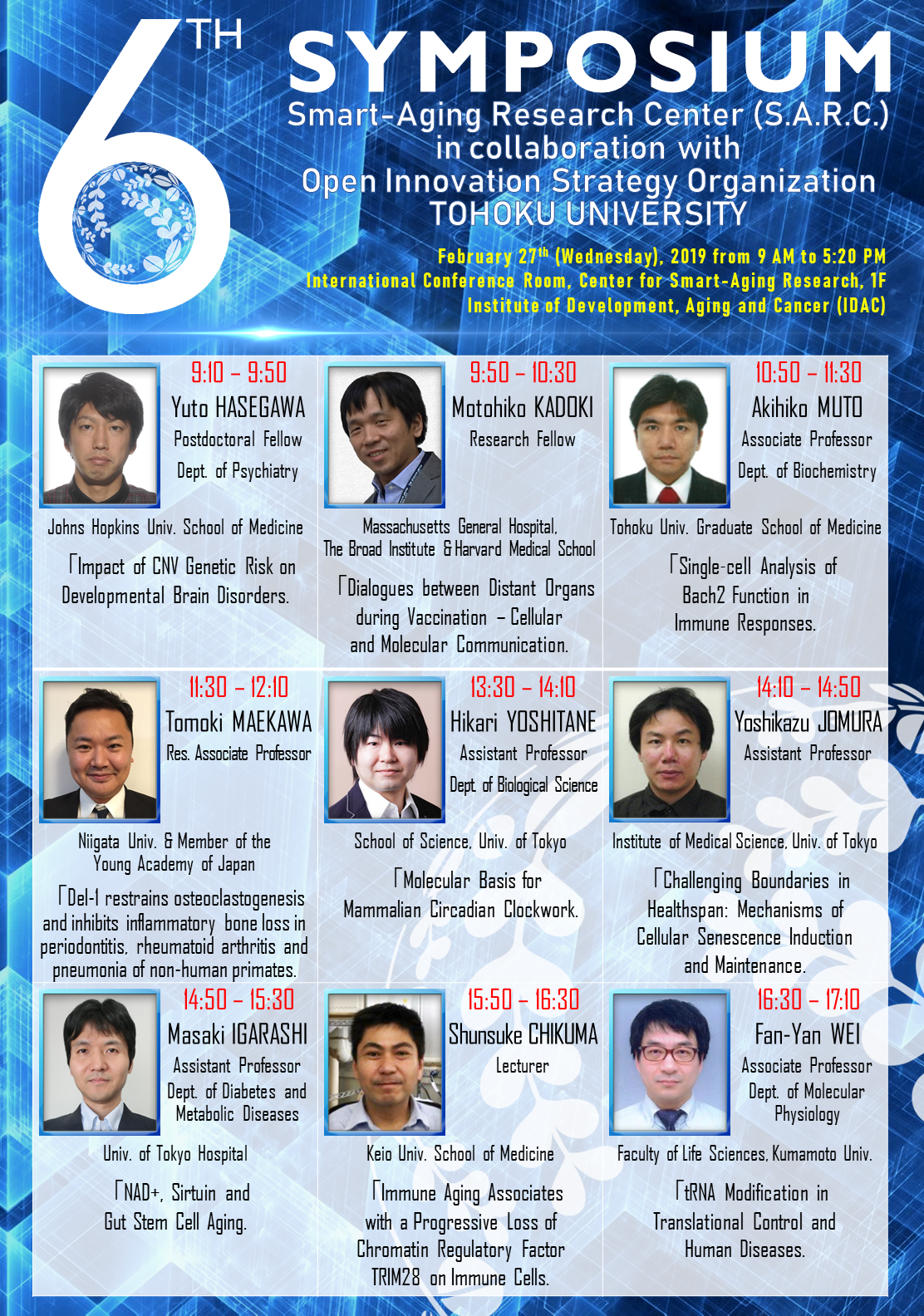
SARC’s 6th Symposium on Dementia Prevention 2019
The 6th Symposium of the Smart-Aging Research Center (S.A.R.C.) in collaboration with the Open Innovation Strategy Organization, will take place on February 27 (Wednesday), from 9 AM to 5:20 PM at the International Conference Room, Center for Smart-Aging Research (1F), IDAC.
Tohoku University’s Smart-Aging Research Center (S.A.R.C.) was established in 2017 to focus on promoting research that is aimed at realizing healthy longevity by conducting research for the prevention and treatment of age-related diseases such as dementia using a multi-tier approach from basic research to medical, ergonomics and social science. Furthermore, S.A.R.C. conducts interdisciplinary activities not only in basic research, but also in social implementation through industry-academia collaborations and ventures.
In this symposium, together with the support of Tohoku University’s Open Innovation Strategy Organization, nine lectures will take place from up and coming researchers that are actively involved in basic research from various life science fields, both locally and globally, with a focus on providing practical applications for a better and healthier society.
To visit S.A.R.C.’s homepage, click on: S.A.R.C.
For more details on S.A.R.C.’s 6th Symposium, please see the poster and program below:
6th Symposium Program (pdf file)
IDAC Seminar to commemorate the retirement of Professor Sato: March 8, 2019
| IDAC Seminar to commemorate the retirement of Professor Sato | |
| Date | Friday, 8 March 2019, 16:00 – 17:00 |
|---|---|
| Room | Smart Aging International Research Center 1F, IDAC |
| Title | My research life in IDAC |
| Speaker | Yasufumi Sato |
| Affiliation | Department of Vascular Biology, Institute of Development, Aging and Cancer, Tohoku University |
| Contact Information | Rie Iida (Department of Vascular Biology・ ext 8532) |
IDAC Seminar (2): February 22, 2019
| Secretariat, Alumni Association, IDAC | |
| Date | Friday, 22 -2 February 2019, 17:00~ |
|---|---|
| Room | 7th Floor, Seminar Room 1, IDAC’s Center for Basic Aging Research |
| Title | Understanding of the immune system based on information of cellular movement by using Kaede mice. |
| Speaker | Michio Tomura |
| Affiliation | Laboratory of Immunology, Faculty of Pharmacy, Osaka Ohtani University |
| Organizer | Koyu Ito (Department of Immunobiology・ext 8579) |
| Abstract | Recently, the importance of regulatory T cells (Tregs) that existed in peripheral tissues (such as skin and gut in maintenance of immune homeostasis) has been explored; however, changes of their movement, phenotype, heterogeneity, and function in the steady state and during inflammation, and their correlations remain unknown. Mouse lines expressing photoconvertible protein “Kaede” or “KikGR” allow us to track immune cell movement in the whole body by marking cells as red in color by exposure to violet light (PNAS 2008, Sci Rep 2014). Here, I will introduce lymphocyte re-circulation, cellular dynamics of Tregs and dendritic cells that migrated from peripheral tissues, high functional Tregs that express multiple immunoinhibitory molecules that existed in inflamed skin and draining LN defined by combination of single cell gene expression analysis (Sci Rep 2016), and Tregs migrated from inflamed colon to dLN (Mucosal Immunol 2018). |
IDAC Seminar: February 22, 2019
| Secretariat, Alumni Association, IDAC | |
| Date | Friday, 22 February 2019, 15:30~ |
|---|---|
| Room | Seminar Room,Center for Smart Aging Research 2F, IDAC |
| Title | Interpersonal Implicit Communication |
| Speaker | Chia-huei Tseng |
| Affiliation | RIEC- Research Institute of Electrical Communication (Tohoku University) |
| Organizer | Dalila Burin (Smart Ageing International Research Center・ext 8585) |
| Abstract | Social communication, which resembles a core difference between machine and human interaction, remains a challenging topic for engineers and neuroscientists. In an aging society like Japan, this is particularly critical for assisted living machinery design as the research results will guide future implementation with social (or interpersonal) value. In this seminar, I will demonstrate how it is possible to use scientific methods to examine the implicit communication via walking step synchronization, brain synchronization, and contagious yawning. I will also discuss about their extension possibilities and collaboration opportunities. |
IDAC Seminar: February 21, 2019
| Secretariat, Alumni Association, IDAC | |
| Date | Thursday, 21 February 2019, 17:30~ |
|---|---|
| Room | 7th Floor, Seminar Room 1, IDAC Center for Basic Aging Research |
| Title | Intracellular connexin protein – its ability to enhance self-renewal of cancer stem cells via induction of adaptive response to ER-stress |
| Speaker | OMORI Yasufumi |
| Affiliation | Department of Molecular and Tumour Pathology, Akita University Graduate School |
| Organizer | OKADA Yoshinori (Department of Thoracic Surgery・ext 8520) | Abstract | Connexin (Cx) is a unique component of gap junction (GJ), which is, however, not a unique function of Cx. Today, Cx is beyond GJ, i.e., Cx can function as GJ-independent hemichannels and even as mitochondrial Cx. It is incontestable that GJ is tumor-suppressive and impaired in an early stage of carcinogenesis. Although aberrant localization of Cx in intracellular domains is one of mechanisms causing disruption of GJ in tumor cells, the amount of intracellular Cx continues to increase during progression in various human cancers, thus suggesting that intracellular Cx should be not only a loss-of-function form but also favorable for cancer progression such as invasion and metastasis. Our group has found that an excessive amount of intracellular Cx induces metastasis both in vitro and in vivo and that intracellular Cx has the potential to enhance self-renewal of cancer stem cells by exploiting a pathway driving an adaptive but not destructive response to endoplasmic reticulum stress. Taken together, while Cx-mediated GJ suppresses carcinogenesis, intracellular accumulation of Cx promotes cancer progression once a tumor has developed. |
151st IDAC Bi-Annual Meeting
IDAC’s 151st Biannual Meeting (an all-English event), will take place on January 25 from 1PM onward at the Center for Smart-Aging Research Building, 1st Floor.
More for details, please see the poster.
IDAC Seminar: January 28, 2019
| Secretariat, Alumni Association, IDAC | |
| Date | Monday, 28 January 2019, 17:00~18:30 |
|---|---|
| Room | 7th Floor,Large-size Conference Room, IDAC Center for Basic Aging Research |
| Title | Analysis of antioxidant mechanism by imidazole dipeptide |
| Speaker | Hideshi Ihara |
| Affiliation | Osaka Prefecture University |
| Organizer | Hozumi Motohashi (Dept. of Gene Expression Regulation・ext 8550) |
IDAC Seminar: December 17, 2018
| Secretariat, Alumni Association, IDAC | |
| Date | Monday, 17 December 2018, 16:00~ |
|---|---|
| Room | Center for Smart Aging Research 1F, IDAC |
| Title | Preclinical functional imaging of rodents for translational study |
| Speaker | Tomokazu Tsurugizawa |
| Affiliation | NeuroSpin/CEA-Saclay, Gif-sur-Yvette, France |
| Organizer | Rie Ryoke (Dept. of Advanced Brain Science・ext 8466) |
| Abstract | Functional MRI (fMRI) is a promising noninvasive tool to investigate neuronal activity by catching changes in the circumstances around the proton (neurovascular coupling, chemical shift and so forth). This technique has been used in clinical studies in a wide field from neuroscience to medical science. Recently, the development of high field MRI provides high resolution and high contrast functional imaging of the rodent brain. Therefore, fMRI is expected for bidirectional translational study between rodent and humans. However, there is still a gap between animal basic research and fMRI research. In this seminar, I will introduce the advantages and limitations of rodent fMRI in addition to recent combination studies of MRI and other neuroscience methods (disease model animals, chemogenetics, electrophysiology and so forth). As this seminar aims to discuss rodent fMRI for translational study, researchers outside the MRI field as well as MRI researchers are welcome to join. |
IDAC Seminar: November 27, 2018
| Secretariat, Alumni Association, IDAC | |
| Date | Tuesday, 27 November 2018, 11:00~ |
|---|---|
| Room | Center for Smart Aging Research 1F, IDAC |
| Title | Meiotic drive: Competition between chromosomes that violates Mendel’s Law. |
| Speaker | Takashi Akera |
| Affiliation | Univ. of Pennsylvania |
| Organizer | Kenji Iemura (Dept. of Molecular Oncology・ext 8490) |
| Abstract | Genetic elements compete for transmission through meiosis when haploid gametes are created from a diploid parent. Mendel’s Law of Segregation states that alleles of a gene are transmitted to gametes with equal probability, but this law can be violated by selfish genetic elements through meiotic drive. Despite the impact of drive on evolution, genetics and reproduction, little is known about the underlying biological cell mechanisms. Female meiosis provides an opportunity for selfish elements to cheat because only chromosomes that segregate to the egg can be transmitted to off springs. Our studies focus on centromeres as selfish elements that bias their segregation through interactions with spindle microtubules. Our results address properties of the meiotic spindle that are exploited by selfish centromeres, activities at centromeres that bias their segregation, and centromere evolution to increase those activities. |
IDAC Seminar: November 12, 2018
| Secretariat, Alumni Association, IDAC | |
| Date | Monday, 12 November 2018, 15:30~ |
|---|---|
| Room | Seminar Room, Center for Smart Aging Research 2F, IDAC |
| Title | The development of senior and intergenerational learning in Taiwan. |
| Speaker | Tsai, Hsiu-Mei |
| Affiliation | Department of Adult and Continuing Education, National Chung Cheng University |
| Organizer | Ryuta Kawashima, Department of Functional Brain Imaging |
| Contact | Rui Nouchi, Department of Functional Brain Imaging・ext 8952 |
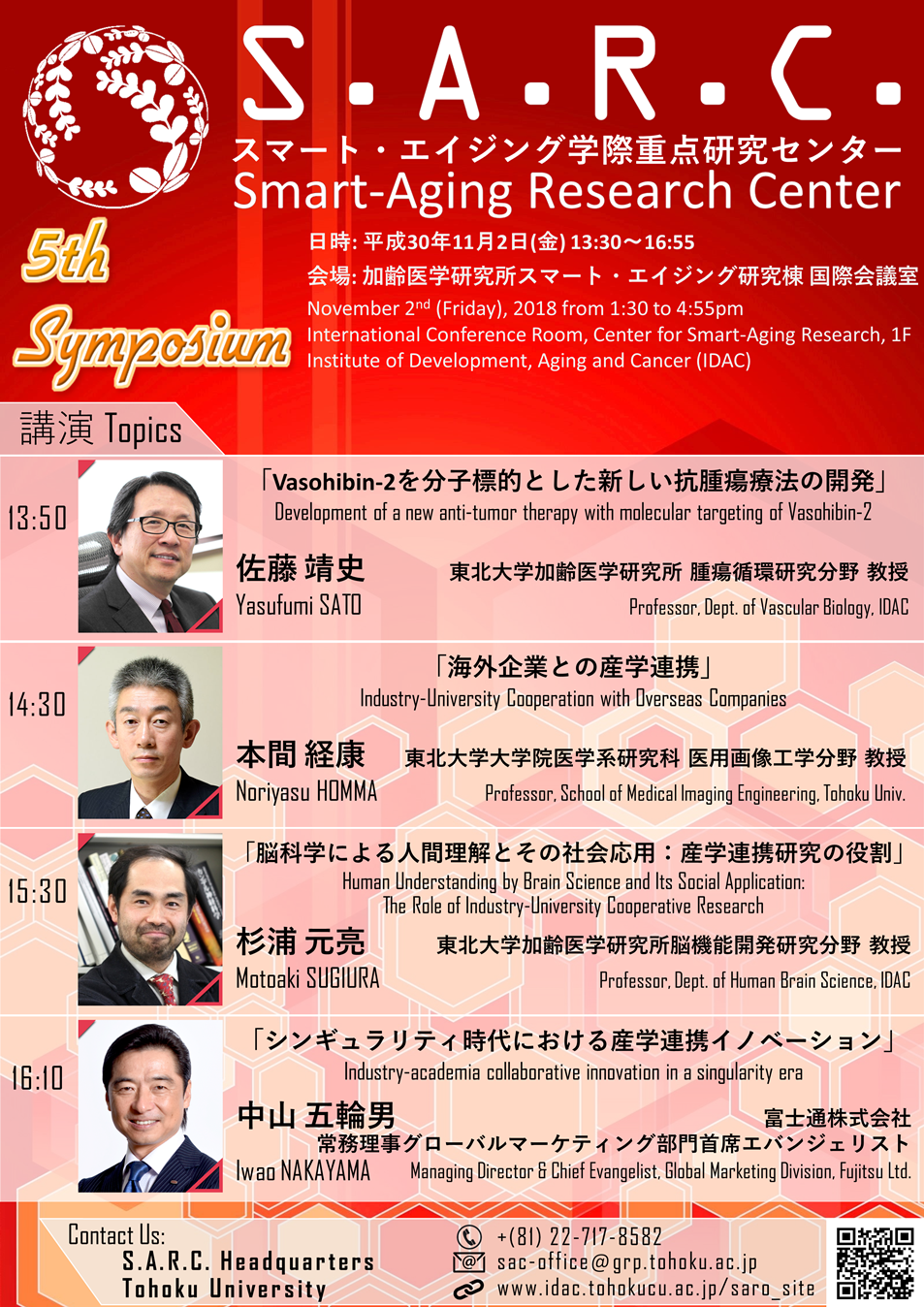
SARC’s 5th Symposium on Dementia Prevention 2018
The 5th Symposium on Dementia Prevention will be held at the Institute of Development, Aging and Cancer (IDAC) on November 2, (Friday), from 1:30 PM – 4:55 PM at the Smart-Aging International Conference Room (Center for Smart-Aging Research, 1st Floor).
Please come and join us as speakers from various academic fields ranging from basic life science to humanities and social work, will come together to advance the development of preventive medicine, develop intervention and assistance technology, and reform medical and social systems through innovative research.
To visit S.A.R.C.’s homepage, click on: S.A.R.C.
For more details on S.A.R.C.’s 5th Symposium, please see the poster below:
IDAC Seminar: September 28, 2018
| Secretariat, Alumni Association, IDAC | |
| Date | Friday, 28 September 2018, 17:00~18:30 |
|---|---|
| Room | 7th Floor, Seminar Room 1, Center for Basic Aging Research, IDAC |
| Title | Redox Regulation of Protein Tyrosine Kinases in Lung Health and Disease |
| Speaker | Albert van der Vliet |
| Affiliation | The University of Vermont |
| Organizer | Hozumi Motohashi (Dept. of Gene Expression Regulation・ext 8550) |
| Abstract | Protein tyrosine kinases play a central role in many cell signaling pathways, and form a major target for drug development. Among these, receptor tyrosine kinases such as the epidermal growth factor (EGFR) and Src family non-receptor tyrosine kinases are widely known for their role in cancer development and progression, and are increasingly appreciated for their involvement in non-malignant diseases such as allergic asthma and fibrotic disease. Tyrosine kinase signaling is subject to redox-dependent regulation, largely through reversible inactivation of protein tyrosine phosphatases. Recent studies by us and others indicate that various NOX-family NADPH oxidases can also promote activation of EGFR and Src in association with H2O2-mediated reversible oxidation of conserved non-catalytic cysteine residues within ATP-binding domains of these kinases, as well as other cysteines. Studies with recombinant enzymes indicated that H2O2-induced activation of these kinases is primarily due to formation of sulfenic acids (-SOH), the primarily product of H2O2-mediated cysteine oxidation, and molecular dynamics (MD) simulations have revealed structural insights into the mechanisms by which cysteine sulfenylation may enhance kinase function, which are related to unique electrostatic interactions with nearby Arg residues. These redox-based mechanisms of EGFR/Src activation were found to be critical for innate responses in airway epithelial cells to injurious triggers or airborne protease allergens, related to activation of the NOX homolog DUOX1. Moreover, enhanced expression and activation of DUOX1 and EGFR/Src within the airway epithelium were found to contribute to pathophysiology of allergic airway disease. Finally, dysregulated redox modifications within Src or EGFR in lung cancers were found to be associated with altered activation and subcellular trafficking of these kinases and increased invasive properties as well as resistance to EGFR-targeted therapies. Collectively, these observations highlight the importance of reversible cysteine modification as a novel redox-dependent regulatory mode in the diverse cellular functions of these protein tyrosine kinases. |
IDAC Seminar: August 21, 2018
| Secretariat, Alumni Association, IDAC | |
| Date | Tuesday, 21 August 2018, 17:00~18:30 |
|---|---|
| Room | 7th Floor, Seminar Room 1, Center for Basic Aging Research, IDAC |
| Title | Analysis of Cancer Metabolism using Multi-Omics Strategies. |
| Speaker | Tomoyoshi Soga |
| Affiliation | Institute for Advanced Biosciences, Keio University |
| Organizer | Hozumi Motohashi (Dept. of Gene Expression Regulation・ext 8550) |
IDAC Seminar: August 6, 2018
| Secretariat, Alumni Association, IDAC | |
| Date | Monday, 6 August 2018, 17:00~18:30 |
|---|---|
| Room | 7th Floor, Seminar Room 1, IDAC Center for Basic Aging Research |
| Title | Fueling T Cells in Inflammation and Cancer |
| Speaker | Jeffrey Rathmell |
| Affiliation | Vanderbilt University School of Medicine |
| Organizer | Hozumi Motohashi (Dept. Gene Expression Regulation・ext 8550) |
| Abstract | Lymphocyte activation leads to rapid proliferation and differentiation and we have shown that CD4 T cell subsets are metabolically distinct. These metabolic distinctions may allow new understanding and approaches to manipulate immunity. We show that T cells in Renal Cell Carcinoma are metabolically suppressed and that improving metabolism can improve T cell function. Glut1 is a member of the glucose transporter family, of which T cells express several members. We have shown that while effector T cells require Glut1 and aerobic glycolysis to promote immunity, Treg can function independent of Glut1 to suppress Inflammatory Bowel Disease (IBD). In addition, T cells consume glutamine through Glutaminase and we show that this metabolic pathway is differentially utilized by effector T cell subsets. Understanding mechanisms that regulate T cell metabolism may provide new tools to modulate immunity the balance of T cell effector and regulatory populations. |
IDAC Seminar: July 26, 2018
| Secretariat, Alumni Association, IDAC | |
| Date | Thursday, 26 July 2018, 10:30~ |
|---|---|
| Room | Seminar Room,Center for Smart Ageing Research 2F,IDAC |
| Title | 1)Diagnosis and Prognosis of neurodegenerative disease by using diffusion MRI 2)Care Models for Older Persons with Hip Fracture: Randomized Clinical Trials |
| Speaker | 1)Jiun-Jie Wang 2)Yea-Ing Lotus Shyu |
| Affiliation | 1)Department of Medical Imaging and Radiological Sciences, Chang Gung University, Taiwan 2)School of Nursing, Chang Gung University, Taiwan |
| Organizer | Kawashima Ryuta (Department of functional brain imaging) Contact:Nouchi Rui (Department of functional brain imaging・ext8952) |
| Abstract | 1) The recent development in diffusion Magnetic Resonance Imaging led to new interests on the studies of neurodegenerative diseases. However, limitations do exist which prevent the techniques from further applications. The reported findings are often controversial because of significant variations, either between studies or patient groups. To obtain unbiased results with respect to the current pathophysiological model, systematic investigations of the brain are therefore required. The presentation will discuss the measurement of diffusion by using MRI and examine the changes of the diffusion properties. We will use diffusion MRI to assess the performance on diagnosis, differential diagnosis, correlation to clinical severity and prognosis on two major neurodegenerative diseases, i.e. Alzheimer Diseases and Parkinson Diseases. In the differential diagnosis of Parkinson Disease, the preliminary results from 551 patients showed that mean diffusivity as assessed by diffusion MRI were found to be significantly higher in patients than in controls, and such differences extended beyond the basal ganglia. Image-based classification for idiopathic Parkinson’s disease had 94.1% sensitivity, 96.1% specificity, 94.9% positive predictive value, and 95.5% negative predictive value. Similar performance can be noticed in the differential diagnosis towards patients with Multiple system atrophy, supranuclear palsy and corticobasal syndrome. In the prognosis study, the predicted clinical severity using 82 patients with Parkinson Disease was consistent with the observed values (adjusted R2 = 0.44–0.86). The highest predictive power from diffusion imaging was identified in the total and the motor subscale of Unified Parkinson’s Disease Rating Scale. The improved diagnosis and prediction of the clinical outcome might ultimately increase the confidence of the neurologist during the therapeutic intervention.
2) Hip fractures result in a 13% to 36% mortality within the first year, a 44% to 55.3% mortality within 4 years after the fracture, and excessive morbidity that severely impedes the patients’ health-related quality of life. Consequently, hip fractures have become a major health issue for older persons. This presentation introduces a series of clinical trials of the care models for the older persons with hip fracture that were funded by the National Health Research Institutes. The first clinical trial examined the effects of an interdisciplinary program consisting of geriatric consultation, continuous rehabilitation, and discharge planning. This interdisciplinary intervention improved the clinical outcome, self-care ability, physical health-related outcomes and decreased the depressive symptoms during the first 24 months after hospital discharge. In the second clinical trial, we developed a comprehensive model that includes not only interdisciplinary care, but also the management of any nutritional problems, fall prevention, and the management of depressive symptoms. During the first 2 years following hip fracture, patients in this comprehensive care group had better performance trajectories for activities of daily living (ADLs) and instrumental ADLs (IADLs), as well as fewer emergency room visits than patients in the usual care group and had less risk of depression and malnutrition than the standard interdisciplinary care during the first year following hip fracture. The third clinical trial examined the effects of a diabetes mellitus (DM)-specific care model for older persons with DM who suffered a hip fracture. DM-specific care model, which integrated interdisciplinary care components with interventions to manage DM has been found to enhance range of motion in hip flexion and muscle strength of the quadriceps of the affected limb, and better overall HRV during the 24 months following hospital discharge above and beyond the effects of usual care and interdisciplinary care. The fourth clinical trial examined the effects of a family-centered care model for hip fractured older persons with cognitive impairment. Future clinical trial using a smart-care model to facilitate fall prevention and rehabilitation adherence was proposed. |
150th IDAC Bi-Annual Meeting
July 20, 2018 from 13:00 – onward at the 1st Floor, Center for Smart Aging Research, IDAC
Schedule of events:
13:00
Opening remarks by Director Ryuta Kawashima, MD
13:05 – 13:50
Sessions 1-3 Chair: Shota Endo
Session 1: Is dysfunction of sensory prediction in patients with schizophrenia related to symptom severity?
Koichi Abe(1,2) Tatsuo kikuchi(2) Kentaro Oba(1) Shinsuke Suzuki(3) Ryo Ishibashi(4) Tetsuya Kageyama(1) Kosuke Motoki(1) Shohei Yamazaki(1) Kazunori Matsumoto(2) Motoaki Sugiura(1,5) Kawashima ryuta(1) Matsuoka hiroo(2)
(1) Department of Human Brain Science, Institute of Development, Aging and Cancer, Tohoku University.
(2) Department of Psychiatry, Tohoku University Graduate School of Medicine.
(3) Frontier Research Institute for Interdisciplinary Sciences.
(4) Smart-Aging Research Center, Tohoku University.
(5) Department of Disaster-Related Cognitive Science, International Research Institute of Disaster Science, Tohoku University.
Session 2: Pressure and Volumetric simulation of pulmonary circulation system using lung specimen for evaluation of Fontan support.
Masato Karube(1) Yasuyuki Shiraishi(2) Akihiro Yamada(2) Yusuke Inoue(2) Aoi Fukaya(1) Tatuya Genda(1) Masaaki Yamagishi(3) Yi Qian(4) and Tomoyuki Yambe(2)
(1) Graduate School of Biomedical Engineering, Tohoku University, Sendai, Japan.
(2) Institute of Development, Aging and Cancer, Tohoku University, Sendai, Japan.
(3) Kyoto Prefectural Medical University, Kyoto, Japan.
(4) Macquarie University, Sydney, Australia.
Session 3: Improvement of unbiased amplification for analysis of immune receptors.
Hiroki Oshio(1,2) Yohiko Suto(2) Koyu Ito(2) Madoka Itabashi(2) Kouetsu Ogasawara(2)
(1) Department of Thoracic Surgery, Graduate School of Medicine, Tohoku University.
(2) Department of Immunobiology, Institute of Development, Aging, and Cancer (IDAC), Tohoku University.
13:50 – 13:5513:55 – 14:40
Sessions 4-6 Chair: Fang Zhenzhou
Session 4: Longitudinal Interleukin-33 injection to APPswe/PSEN1dE9 mice with longitudinal behavioural and MRI assessment.
Ryan Browne(1) Rie Ryoke(1) Mitsunari Abe(2) Hiroi Nonaka(1) Masatoshi Hirobe(1) Ryuta Kawashima(1)
(1) Department of Functional Brain Imaging, Tohoku University, Sendai, Japan.
(2) Department of Neurology, Fukushima Medical University, Fukushima, Japan.
Session 5: Increased gray matter volume of the right superior temporal gyrus in healthy children with autistic cognitive style: a VBM study.
Akiko Kobayashi(1) Susumu Yokota(2) Hikaru Takeuchi(3) Kohei Asano(4) Michiko Asano(1,5) Yuko Sassa(3) Yasuyuki Taki(6) Ryuta Kawashima(1,3)
(1) Department of Advanced Brain Science, Institute of Development, Aging and Cancer, Tohoku University.
(2) Faculty of art and science, Kyushu University.
(3) Division of Developmental Cognitive Neuroscience, Institute of Development, Aging and Cancer, Tohoku University.
(4) Kokoro Research Center, Kyoto University.
(5) Global Research Center for Logic and Sensibility, Keio University.
(6) Department of Nuclear Medicine and Radiology, Institute of Development, Aging and Cancer, Tohoku University.
Session 6: Photoacoustic imaging contrast agent.
Syahril Siregar and Yoshifumi Saijo
Graduate school of biomedical engineering, Tohoku University Sendai Japan.
14:40 – 14:55
COFFEE BREAK
14:55 – 15:40
Sessions 7-9 Chair: Yasuko Tatewaki
Session 7: Identification of the X-linked germ cell specific miRNAs (XmiRs) and their functions.
Hiromitsu Ota, Yumi Ito-Matsuoka, Yasuhisa Matsui
Cell Resource Center for Biomedical Research, Institute of Development, Aging and Cancer, Tohoku University.
Session 8: Over expression of BRCA1-interracting protein BIP2 induces centrosome.
Akihiro Kobayashi, Yuki Yoshino, Zhenghao Chen, Shino Endo, Huicheng Qi, Zhenzhou Fang and Natsuko Chiba
Department of Cancer Biology, Institute of Development, Agingand Cancer, Tohoku University.
Session 9: Effects of the (Pro)renin receptor gene polymorphism on brain structure and cognitive function.
Tomoko Totsune(1) Kazuhito Totsune(2) Manabu Nakagawa(1,3) Hikaru Takeuchi(5) Hiroaki Tomita(4) Ryuta Kawashima(6) Yasuyuki Taki(1)
(1) Dept. of Nuclear Medicine and Radiology, IDAC, Tohoku University, Japan.
(2) Koujinkai chuou clinic, Sendai,Miyagi, Japan.
(3) Kousei Sendai Clinic, Sendai, Miyagi, Japan.
(4) Dept. of Disaster Psychiatry, IRIDS, Tohoku University, Japan.
(5) Div. of Developmental Cognitive Neuroscience, IDAC, Tohoku University, Japan.
(6) S.A.R.C., IDAC, Tohoku University, Japan.
15:40 – 15:45
Closing remarks by Professor Hozumi Motohashi
IDAC Seminar: July 12, 2018
| Secretariat, Alumni Association, IDAC | |
| Date | Thursday, 12 July 2018, 16:00 – onwards |
|---|---|
| Room | 7th Floor, Seminar Room 1, IDAC Center for Basic Aging Research |
| Title | Lymphocyte Proliferation in protective immunity and oncogenesis |
| Speaker | Takeshi Egawa |
| Affiliation | Department of Pathology and Immunology Washington University school of Medicine |
| Organizer | Yasuhisa Matsui (Cell Resource Center for Biomedical Research・ext 8571) |
| Abstract | Clonal expansion of lymphocytes is an essential process for both the development of lymphocytes with diverse antigen receptor repertoires and the amplification of antigen-specific adaptive immunity. Lymphocyte precursors undergo rapid clonal expansion during their development to establish diverse antigen (Ag)-receptor repertoires. During immune responses, Ag-specific T and B cells that are present under steady state conditions at very low frequencies increase their numbers by rapid clonal expansion. Such robust increase in cell numbers is essential to quantitatively amplify their immune responses and as well as to generate high-affinity, mutated antibodies in the germinal centers (GCs). However, clonal expansion is a metabolically demanding process that requires extensive bio-genesis. Proliferating lymphocyte precursors and GC B cells are also exposed to substantial genomic insults associated with activities of RAG and AID proteins in addition to replication-related mutation, presumably leading to the elevated risk of oncogenic transformation. Lymphocytes may thus employ unique programs to facilitate their clonal expansion while minimizing collateral genome damage. However, our knowledge about these regulatory pathways remains limited. To address this question, we have studied gene expression programs initiated by the transcription factor c-MYC, which is essential for proliferation of normal lymphocytes and implicated in oncogenesis. Through these studies, we have identified MYC downstream gene expression programs that facilitate requisite clonal expansion of lymphocytes for protective immunity and protect proliferating lymphocytes from oncogenesis. These findings not only reveal the genetic pathways critical for host protection from infection but also demonstrate that the proto-oncogene MYC engages a tumor suppressor program. |
IDAC Seminar: June 21, 2018
| Secretariat, Alumni Association, IDAC | |
| Date | Thursday, 21 June 2018, 18:30~19:30 |
|---|---|
| Room | 1st Floor, Center for Smart Aging Research, IDAC |
| Title | Future perspective of medical care for the elderly |
| Speaker | Hidenori ARAI |
| Affiliation | Hospital Director, National Center for Geriatrics and Gerontology |
| Organizer | Hisanori Horiuchi (Department of Molecular and Cellular Biology・ext 8463) |
2019 International Joint Usage and Collaborative Research Program

Exploratory research using aged C57BL/6J mice provided by the Institute of Development, Aging and Cancer (IDAC), TOHOKU UNIVERSITY
As part of IDAC’s 2019 International Joint Usage and Collaborative Research Program, we would like to propose conducting research using aged C57BL/6J mice.
At our institute’s Animal Experiment Facility, the following will be provided:
a set of 27-30 months and 4-5 months old C57BL/6J background wild-type male mice in groups of 5-6 animals per cage.
Examples of experimental usage:
1. To attain comprehensive data such as transcriptome, epigenome, proteome and metabolome using plasma, tissues and organs and specific cell lineages.
2. Physiological functional tests such as motor function, behavior, stimulus response and metabolic control ability.
3. Cell biology experiment using flow cytometry.
We welcome proposals to evaluate age-related changes of normal mice in highly original experimental systems.
For more details, please download the following:
Exploratory Research Using Aged C57BL/6J Mice (pdf file)
Proposal Form (pdf file)