
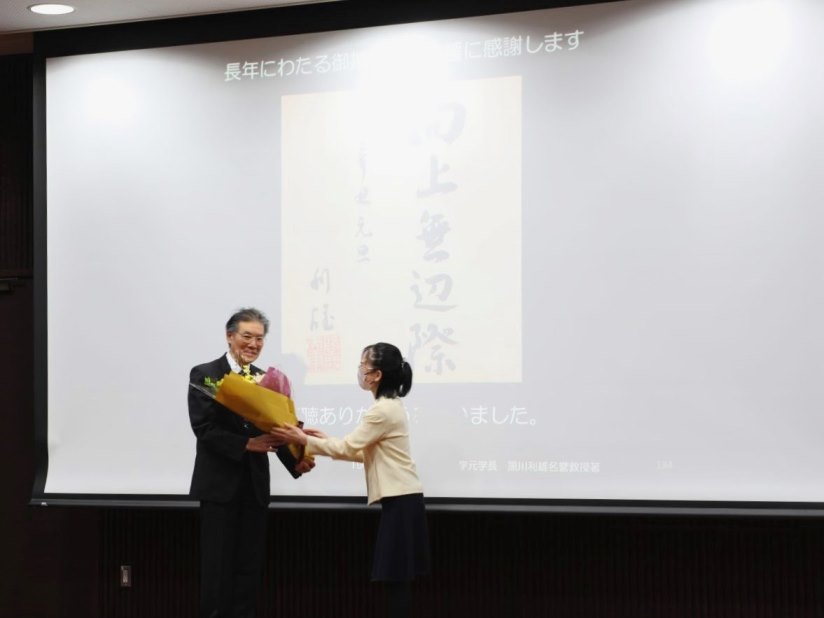
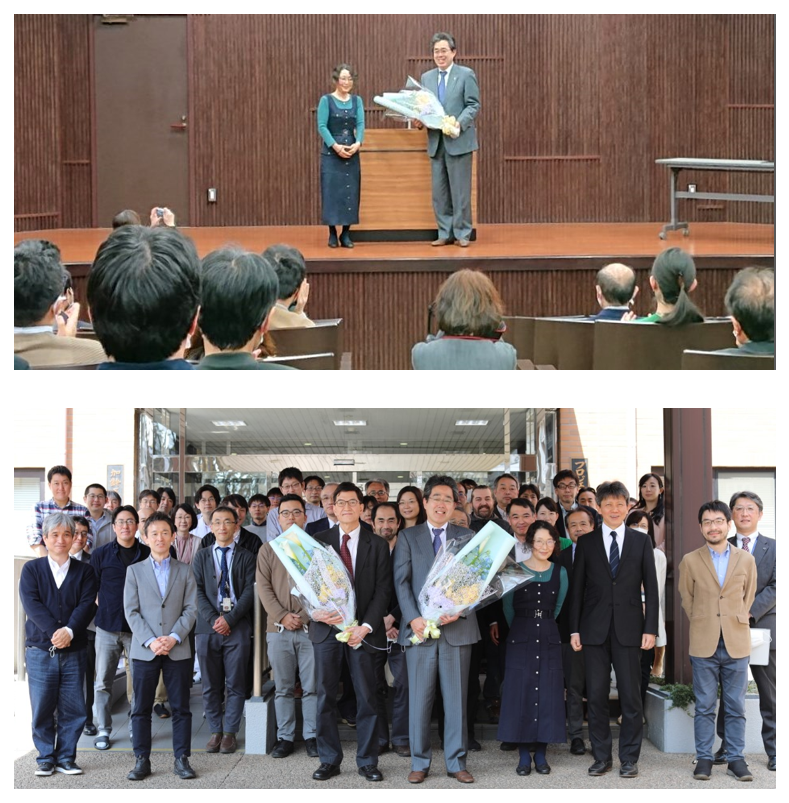
IDAC’s Professor Chikashi Ishioka from the Department of Clinical Oncology will retire from his tenure as Professor from the Institute of Development, Aging and Cancer (IDAC) on March 31, 2024. A retirement ceremony was held on March 11, 2024.
Institute of Development, Aging and Cancer, Tohoku University
The Institute of Development, Aging and Cancer (IDAC) elucidates the basic mechanisms of aging, from the birth of life to development, maturation, aging and death.
IDAC’s Professor Chikashi Ishioka from the Department of Clinical Oncology will retire from his tenure as Professor from the Institute of Development, Aging and Cancer (IDAC) on March 31, 2024. A retirement ceremony was held on March 11, 2024.
| IDAC Seminar to commemorate the retirement of Professor Horiuchi | |
| Date | Tuesday, 14 March 2024, 16:00〜 |
|---|---|
| Room | International Conference Room, Center for Smart-Aging Research, 1F, (IDAC) |
| Title | Thanks for Genuine support by my mentor scientists and colleagues. |
| Speaker | Professor Hisanori Horiuchi |
| Affiliation | Department of Molecular and Cellular Biology, Institute of Development, Aging and Cancer, Tohoku University |
| Organizer | Ryutaro Shirakawa (Dept. of Molecular and Cellular Biology・ext 8463) |
| IDAC Seminar to commemorate the retirement of Professor Ishioka | |
| Date | Monday, 11 March 2024, 16:00〜 |
|---|---|
| Room | International Conference Room, Center for Smart-Aging Research, 1F, (IDAC) |
| Title | Perspective of personalized cancer medicine. |
| Speaker | Professor Chikashi Ishioka |
| Affiliation | Department of Clinical Oncology, Tohoku University School of Medicine |
| Organizer | Masanobu Takahashi(Dept. of Clinical Oncology・ext 8543) Syonosuke Wakayama (Dept. of Clinical Oncology・ext 8543) |
| Abstract | Cancer has been the leading cause of death in Japan and other OECD countries for a long time, but the age-adjusted morbidity and mortality rates of cancer patients are gradually improving through a wide range of cancer acts, including improvements in prevention, screening and treatment methods. However, treatment outcomes for advanced cancer have not yet reached a level that satisfies patients and their families. Cancer drug therapy, which is the mainstay of treatment for unresectable advanced and recurrent cancers, has improved by developing new cancer molecular targeting drugs and improving technologies on comprehensive molecular analyses such as cancer genome analysis. Cancer treatment is rapidly moving toward an era of individualization, with a shift from organ-specific cancer treatment to organ-agnostic treatment based on the mechanisms of cancer development and progression. In this lecture, I will look back on my 40 years of research as a medical oncologist, summarize the trends, achievements, and challenges in the developing field of personalized cancer medicine, and look at the future direction of this field. |
| Secretariat, Alumni Association, IDAC | |
| Date | Thursday, 7 March 2024, 13:00~14:00 |
|---|---|
| Room | 7th Floor, Seminar Room 1,IDAC Center for Basic Aging Research |
| Title | m6A and pseudouridine (Ψ) in vertebrate mRNA. |
| Speaker | Professor. Dr. Sabastian Leidel |
| Affiliation | Research Group for RNA Biochemistry Department of Chemistry, Biochemistry and Pharmaceutical Sciences (DCBP) University of Bern Hochschulstrasse 6, Bern, Canton of Bern, 3012, Switzerland |
| Organizer | FANYAN WEI (Dept. Modomics Biology and Medicine, ext. 8562) |
| Abstract | Chemical RNA modifications affect all aspects of RNA biology, including biogenesis, turnover, and tuning the interactions of RNA molecules. I will present two current stories from my lab involving mRNA and tRNA modifications. First, in collaboration with Sebastian Glatt’s group (Krakow, Poland), we solved the structure of human PUS3 and performed several biochemical assays to understand how the absence of Ψ is associated with disease. Interestingly, our findings strongly argue against a role of PUS3 in mRNA modification, but reveal how the highly conserved PUS3 ensures target specificity. Second, to understand the role of N6-methyladenosine (m6A) during vertebrate development, we deleted Mettl3 in zebrafish. mettl3-/- fish die within the first month after fertilization. We combined RNA-seq and single-cell RNA-seq of Mettl3-/- mutant heads to analyze the molecular phenotypes. Strikingly, genes associated with eye disease are dysregulated and histological analysis revealed significant morphological changes of the mutant retinas, while electroretinography uncovered visual defects. Furthermore, mettl3-/- mutants displayed defects in locomotor activity in automated dark-light transition experiments, a phenotype that worsened over time. Finally, we found that mutant cells respond to the lack of m6A by regulating the splicing of wtap, the scaffold member of the m6A-writer complex. |
| IDAC Seminar to commemorate the retirement of Professor Ogura | |
| Date | Friday, 1 March 2024, 15:00〜 |
|---|---|
| Room | International Conference Room, Center for Smart-Aging Research, 1F, (IDAC) |
| Title | From 1984 to 2024, making a long and winding loop. |
| Speaker | Professor Toshihiko Ogura |
| Affiliation | Department of Developmental Neurobiology,Institute of Development,Aging and Cancer, Tohoku University |
| Organizer | Ken Matsumoto (Dept. Developmental Neurobiology ext 8596 |
IDAC’s 161st Biannual Meeting (an all-English event), will take place on February 2, 2024 from 1PM onwards at the International Conference Room on the 1st floor of the SA Building.
For more details, please click to see the PROGRAM.
| Secretariat, Alumni Association, IDAC | |
| Date | Monday, 29 January 2024, 14:00~ |
|---|---|
| Room | Smart-Aging building 4F Seminar Room, 4 Seiryomachi, Aoba Ward, Sendai, Miyagi |
| Title | Old friend, new enemy: Cytomegalovirus, a hidden influencer of mental health. |
| Speaker | Haixia Zheng |
| Affiliation | Laureate Institute for Brain Research, Tulsa, OK, USA |
| Organizer | Ye Zhang (Department of Aging Research and Geriatric Medicine・ext 8556) |
| Abstract | Neuroinflammation has long been suspected as a key driver in various neuropsychiatric disorders, yet pinpointing its source has remained a challenge. Among potential contributors, neurotrophic herpesviruses, including Cytomegalovirus (CMV), have recently resurfaced in scientific discussions. CMV, a herpesvirus family member, is known for its ability to remain dormant in the human body for life, often reactivating under psychological stress or during inflammatory responses. Our research team has delved into CMV’s significant yet often overlooked role in neuropsychiatric conditions like major depressive disorder (MDD), schizophrenia, and outcomes from sports-related concussions. Through a comprehensive approach encompassing epidemiological studies, neuroimaging, and post-mortem analyses, we have uncovered compelling correlations between CMV seropositivity and several neurobiological markers. Our findings reveal notable changes in brain structure and function, including reduced gray matter volume, compromised white matter integrity, and diminished functional connectivity in key neural networks, especially in CMV-positive MDD patients. Furthermore, our investigations have highlighted a connection between CMV infection and neuroinflammation, evidenced by increased microglia activation and higher levels of inflammation-related gene expression. We propose a novel model suggesting that the immune response to CMV activity could directly or indirectly trigger neuroinflammation, which is crucial in altering brain microstructure and neurotransmitter systems involved in cognitive and mood regulation. This exploration into CMV’s role in mental health not only deepens our understanding of the inflamed biotype of neuropsychiatric disorders but also emphasizes the need to merge immunology with neuroscience to facilitate our strategies for improving patient outcomes in mental health. |
| Secretariat, Alumni Association, IDAC | |
| Date | Monday, 11 December 2023, 15:30~ |
|---|---|
| Room | 7th Floor, Seminar Room 1,IDAC Center for Basic Aging Research |
| Title | NAD World 3.0 The importance of inter-tissue communications in mammalian aging and longevity control and anti-aging intervention. |
| Speaker | Shin-ichiro Imai, MD, PhD Theodore and Bertha Bryan Distinguished Professor |
| Affiliation | Department of Developmental Biology, Department of Medicine (Joint), Washington University School of Medicine |
| Organizer | Akiko Satoh (Department of Integrative Physiology, ext. 8544) |
| Abstract | Our major objective is to understand a systemic regulatory network for mammalian aging and longevity control and translate the knowledge to an effective anti-aging intervention for humans. Recently, we have identified a specific neural population in the dorsomedial hypothalamus (DMH) that counteracts aging and promotes longevity through the control of a feedback loop between the hypothalamus and white adipose tissue (WAT). These neurons send a signal to WAT through the sympathetic nervous system, stimulating the secretion of extracellular vesicles (EVs) that contain extracellular nicotinamide phosphoribosyltransferase (eNAMPT-EVs). eNAMPT-EVs then increases hypothalamic NAD+ levels, particularly in the DMH. We have demonstrated that stimulating this feedback loop can delay aging and extend lifespan in mice. On the other hand, nicotinamide mononucleotide (NMN), a key NAD+ intermediate, has been proven to show significant anti-aging effects in mice and also has been reported to show significant beneficial effects in several human clinical trials. In this seminar, I will discuss the importance of inter-tissue communications for mammalian aging and longevity control and anti-aging intervention to aim to accomplish “Productive Aging” in our society. |
| Secretariat, Alumni Association, IDAC | |
| Date | Monday, 6 November 2023, 12:00~13:30 |
|---|---|
| Room | 7th Floor, Large-size Conference Room ,IDAC Center for. Basic Aging Research |
| Title | Uncovering the mechanisms of disease progression in genetic subsets of lung cancer |
| Speaker | Thales Y. Papagiannakopoulos, PhD |
| Affiliation | Department of Pathology, New York University Grossman School of Medicine/Laura and Isaac Perlmutter NYU Cancer Center, New York University Grossman School of Medicine |
| Organizer | Hozumi Motohashi (Dept. Gene Expression Regulation・ext 8550) |
| Abstract | KRAS mutant lung adenocarcinoma is the major form of lung cancer that remains a major challenge for clinical oncology because patients are refractory to standard-of-care. KRAS mutant tumors display a high degree of genetic heterogeneity and emerging clinical data suggest that specific KRAS co-mutations are associated with poor prognosis and failure of cancer therapies. Our group uses genetically engineered mouse models and patient samples to dissect how genetic subsets of KRAS mutant lung cancer promote tumorigenesis by rewiring cancer cell metabolism, promoting immune evasion and therefore contributing to tumor progression and therapy resistance. We have identified novel therapeutic approaches to both suppress tumor metabolism and reverse the immunosuppressive microenvironment of genetic subsets of KRAS-driven lung cancer. Furthermore, our group is investigating how cancer as a systemic disease can lead to dysfunction of multiple organ systems, which is observed in many lung cancer patients. We are dissecting the interplay of tumor mutations, nutrition and changes in systemic physiology during tumorigenesis. Our preliminary studies highlight that genetic subtypes of KRAS mutant lung cancer can interact with common diets to disrupt systemic physiology. We aim to identify and therapeutically target the underlying mechanisms in order to restore homeostatic control of physiological functions. |
| Secretariat, Alumni Association, IDAC | |
| Date | Wednesday, 11 October 2023, 17:30~19:00 |
|---|---|
| Room | 7th Floor, Seminar Room 1,IDAC Center for Basic Aging Research |
| Title | Small Molecule Components of GATA Factor-dependent Regulatory Networks Governing the Development and Function of Stem and Progenitor Cells |
| Speaker | Emery H. Bresnick, Ph.D |
| Affiliation | University of Wisconsin School of Medicine and Public Health |
| Organizer | Hozumi Motohashi (Dept. Gene Expression Regulation・ext8550) |
| Abstract | A plethora of malignant and non-malignant hematology disorders involve disruption of gene- and protein-regulatory networks. This is exemplified by genetic and epigenetic alterations in mechanisms involving members of the GATA transcription factor family, which cause anemia, immunodeficiency, bone marrow failure and leukemia (Katsumura et al. Blood 2017; Churpek and Bresnick, JCI 2019). Our studies to elucidate GATA1- and GATA2-dependent networks revealed numerous small molecule transporters and biosynthetic enzymes as network components (Fujiwara et al. Mol. Cell 2009; Johnson et al. Science Adv. 2015; Mehta et al. Cell Rep. 2017; Zwifelhofer et al. PLOS Genet. 2020; Johnson et al. JEM 2020). By establishing and maintaining small molecule ensembles in cells, these components generate cell-autonomous and non-cell-autonomous mechanisms that govern the development and function of hematopoietic stem/progenitor cells and their progeny. I will discuss recent multiomic analyses that led to the discovery that GATA1 dictates the levels of bioactive lipids by regulating genes encoding the enzymatic machinery. Utilizing genetic editing to rewire the regulatory circuitry and complementary pharmacological approaches, we established a mechanism in which GATA1-regulated bioactive lipids control cytokine receptor signaling as an essential determinant of erythrocyte development. We expect that this mechanistic framework can be extrapolated to GATA factor mechanisms operating at various levels of the hematopoietic system physiologically and in inflammation-related pathological states. |
| Secretariat, Alumni Association, IDAC | |
| Date | Monday, 25 September 2023, 17:00~18:30 |
|---|---|
| Room | 7th Floor, Seminar Room 1, IDAC Center for Basic Aging Research |
| Title | Identification of Druggable and Redox Vulnerabilities in Cancer |
| Speaker | Liron Bar-Peled, PhD |
| Affiliation | MGH Cancer Center, Harvard Medical School Department of Medicine |
| Organizer | Hozumi Motohashi (Dept. Gene Expression Regulation・ext 8550) |
| Abstract | Multiple chemotherapies are proposed to cause cell death in part by increasing the steady-state levels of cellular reactive oxygen species (ROS). However, for most of these drugs exactly how the resultant ROS function and are sensed is poorly understood. In particular, it’s unclear which proteins the ROS modify and their roles in chemotherapy sensitivity/resistance. To answer these questions, we examined 11 chemotherapies with an integrated proteogenomic approach identifying many unique targets for these drugs but also shared ones including ribosomal components, suggesting one mechanism by which chemotherapies regulate translation. We focus on CHK1 which we find is a nuclear H2O2 sensor that promotes an anti-ROS cellular program. CHK1 acts by phosphorylating the mitochondrial-DNA binding protein SSBP1, preventing its mitochondrial localization, which in turn decreases nuclear H2O2. Our results reveal a druggable nucleus-to-mitochondria ROS sensing pathway required to resolve nuclear H2O2 accumulation, which mediates resistance to platinum-based chemotherapies in ovarian cancers. |
| Secretariat, Alumni Association, IDAC | |
| Date | Friday, 28 July 2023, 16:00~ |
|---|---|
| Room | International Conference Room, Center for Smart-Aging Research, 1F (IDAC) |
| Title | Transgenerationalinheritance of epigenetic signatures in mammals |
| Speaker | Yuta Takahashi |
| Affiliation | Altos Labs |
| Organizer | Hiroki Sekine, Department of Gene Expression Regulation, ext 8553 |
| Abstract | Transgenerational epigenetic inheritance in mammals remains a debated subject. We recently demonstrated that DNA methylation of promoter-associated CpG islands (CGIs) can be transmitted from parents to their offspring in mice (Takahashi, Cell. 2023). We generated DNA methylation-edited mouse embryonic stem cells (ESCs) in which CGIs of two metabolism related genes were specifically methylated and silenced using our DNA methylation editing strategy (Takahashi, Science. 2017). DNA methylation-edited mice generated by microinjection of the methylated ESCs exhibited abnormal metabolic phenotypes. Both the acquired methylation of the targeted CGI and the phenotypic traits were maintained and transmitted across multiple generations. The heritable CGI methylation was subjected to reprograming in parental PGCs and subsequently reestablished in the next generation at post-implantation stages. In this meeting, I would like to discuss the mechanism underlying transgenerational epigenetic inheritance in mammals.
Takahashi Y. et al. Transgenerational inheritance of acquired epigenetic signatures at CpG islands in mice. Cell. 2023; 186: 4, 715-731 Takahashi Y. et al. Integration of CpG-free DNA induces de novo methylation of CpG islands in pluripotent stem cells. Science. 2017; 356: 503-508. |
| Secretariat, Alumni Association, IDAC | |
| Date | Wednesday, 20 September 2023, 13:00~14:30 |
|---|---|
| Room | 7th Floor, Seminar Room 1, IDAC Center for Basic Aging Research |
| Title | Malignant consequences of redox signaling in pancreatic cancer |
| Speaker | Iok In Christine Chio, PhD |
| Affiliation | Genetics and Development, Institute for Cancer Genetics, Columbia University Medical Center |
| Organizer | Hozumi Motohashi (Dept. Gene Expression Regulation・ext 8550) |
| Abstract | The impact of reactive oxygen species (ROS) on cancer is complex, especially given their context-dependent ability to either promote or suppress tumorigenesis. Interpreting the effects of ROS on cellular behavior is further complicated by their dual potential to indiscriminately oxidize macromolecules or to selectively oxidize redox-reactive residues of target proteins. Indeed, the thiol group of proteinaceous cysteines can serve as a reversible redox switch that regulates distinct signaling outcomes. For example, using our pancreatic organoid model, we previously showed that redox signaling through specific cysteine residues promotes protein synthesis (Cell, 2016) and tumor cell viability in pancreatic ductal adenocarcinoma (PDA) (Nat Comms, 2019). Nonetheless, it remains unclear whether redox signaling mechanisms also contribute to the high metastatic potential of PDA and, thus, the dismal prognosis associated with this malignancy. In addition to cysteine, methionine residuesharbor a redox-reactive sulfur atom that can be oxidized to methionine sulfoxide and then reduced back to methionine by methionine sulfoxide reductase A (MSRA). Based on our recent discovery that MSRA is a potent suppressor of PDA metastasis (Molecular Cell, 2022), we postulate that site-specific methionine oxidation directly regulates PDA tumorigenesis. To this end, we performed quantitative chemoproteomic analysis of the methionine proteomes of PDA cells and immune cells during disease progression and identified specific proteinaceous methionine oxidation events that support metastasis. |
IDAC’s 160th Biannual Meeting (an all-English event), will take place on July 14, 2023 from 1PM onwards at the International Conference Room on the 1st floor of the SA Building.
For more details, please click to see the PROGRAM.
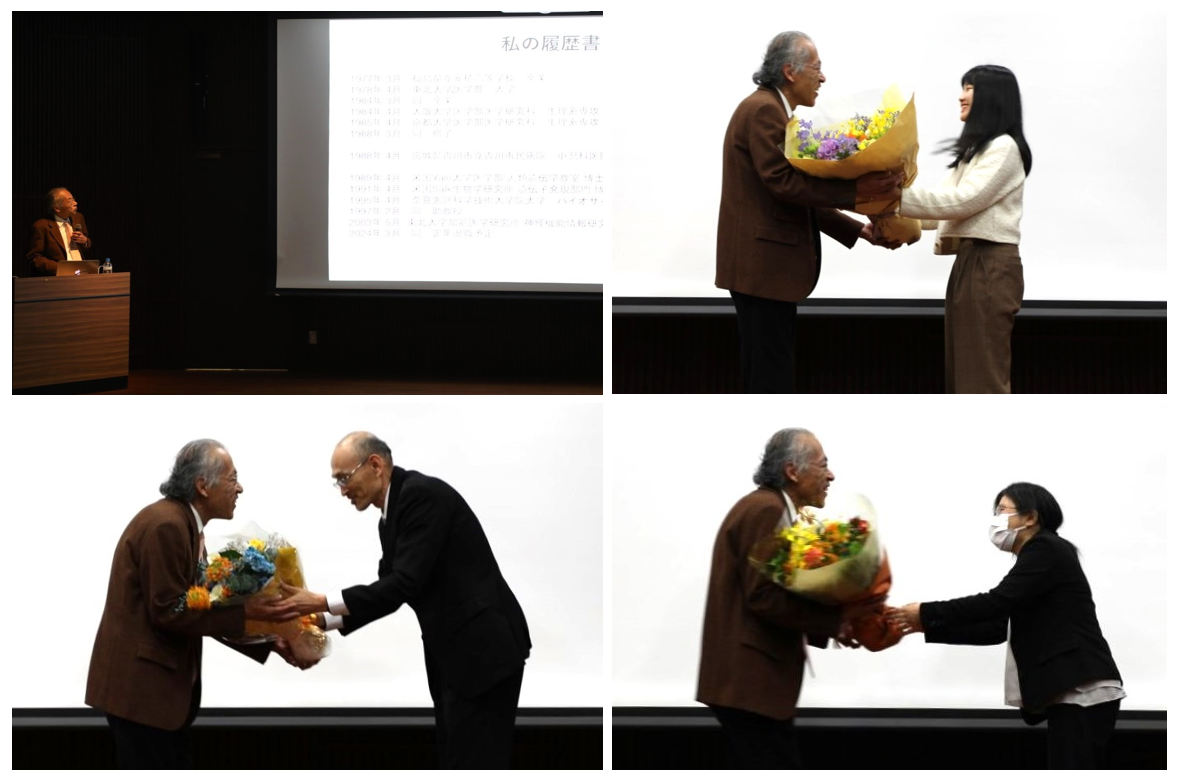
IDAC’s Professor Toshihiko Ogura from the Department of Developmental Neurobiology will retire from his tenure as Professor from the Institute of Development, Aging and Cancer (IDAC) on March 31, 2024. A retirement ceremony was held last week on March 1, 2024.
IDAC will begin public recruitment for Joint Use & Joint Research according to the guidelines below, so please feel free to apply.
[Download Application Procedures]
[CLICK TO DOWNLOAD APPLICATION PROCEDURES]
[Download Application Form]
[CLICK TO DOWNLOAD APPLICATION FORM]
[Contact]
Research Promotion Section, IDAC
Tel: 022-717-8445
E-mail: ida-sen@grp.tohoku.ac.jp
| Secretariat, Alumni Association, IDAC | |
| Date | Wednesday, 7 June 2023, 14:30~15:45 |
|---|---|
| Room | Smart-Aging building 4F Seminar Room, Web |
| Title | The Evolution and Impact of Deep Learning: From Image Recognition to Natural Language Processing |
| Speaker | Atsushi Koike Ph.D |
| Affiliation | Associate Professor, Education Section for Practical IT, Graduate School of Information Sciences, Tohoku University |
| Organizer | Yasuyuki Taki (Dept. of Aging Research and Geriatric Medicine・ext 8559) Yasuko Tatewaki (Dept.of Aging Research and Geriatric Medicine・ext 8559) |
| Abstract | This lecture explores the evolution and impact of deep learning, particularly from a broad perspective spanning from image recognition to natural language processing. In recent years, deep learning has seen remarkable advancements, with its utility and influence being recognized in numerous fields. Firstly, we provide an overview of the latest advancements in deep learning within the realm of image recognition. We delve into the details of how this field is rapidly progressing through new architectures, algorithms, and other technological innovations. Next, we focus on the application of deep learning in natural language processing. Specifically, we discuss how the latest models and technologies contribute to natural language understanding and generation. Finally, we contemplate how these research trends impact the overall development of deep learning and consider future possibilities. This lecture serves as a foundation for understanding the current state of deep learning and predicting its future advancements. |
| Secretariat, Alumni Association, IDAC | |
| Date | Monday, 15 May 2023, 16:00~17:00 |
|---|---|
| Room | International Conference Room, Center for Smart-Aging Research,1F (IDAC) |
| Title | RAD52 and BRCA2 regulate pathway usage in double-stranded DNA break repair |
| Speaker | Prof. Dr. Wolf-Dietrich Heyer |
| Affiliation | Distinguished Professor and Chair, Department of Microbiology & Molecular Genetics, Co-leader Molecular Oncology Program UC Davis Comprehensive Cancer Center, University of California, CA 95616-8665, USA |
| Organizer | Akira Yasui (Department of Molecular Oncology・ext8465) |
| Abstract | BRCA2-mutant cells are defective in homologous recombination, making them vulnerable to the inactivation of other pathways for repairing DNA double-strand breaks (DSBs). This concept can be clinically exploited but is currently limited due to insufficient knowledge about how DSBs are repaired in the absence of BRCA2. We show that DNA polymerase θ (POLθ)-mediated end-joining (TMEJ) repairs DSBs arising during S phase in BRCA2-deficient cells only after the onset of the following mitosis. This process is regulated by RAD52, whose loss causes the premature usage of TMEJ and the formation of chromosomal fusions. Purified RAD52 and BRCA2 proteins both block the DNA polymerase function of POLθ, providing a mechanism of why the combined loss is synthetically lethal. We propose that the delay of TMEJ until mitosis ensures the conversion of originally one-ended into two-ended DSBs. Mitotic chromatin condensation might further serve to juxtapose correct break ends and limit chromosomal fusions. |
EU Ministers and Delegation visits IDAC!
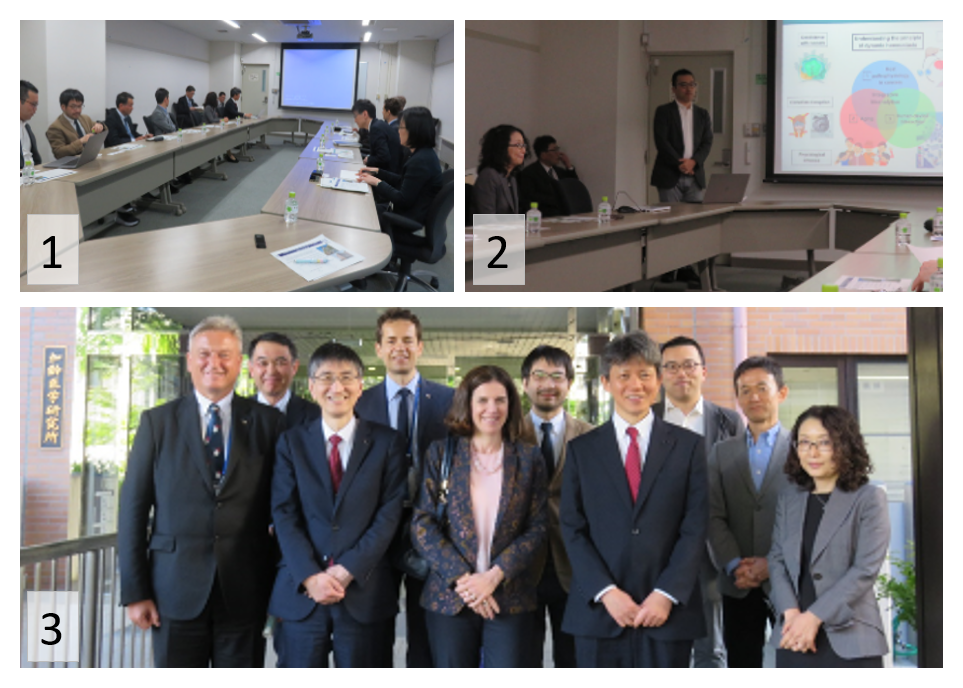
Ms. Maria-Cristina Russo (Director for Global Approach and International Cooperation in Research and Innovation, European Commission) and members of the EU delegation to Japan visited IDAC on May 11 (Thursday). This visit is related to the G7 Science and Technology Ministers’ Meeting in Sendai, and IDAC’s Director and Professor Kozo TANAKA gave an overview of the history and research activity at the Institute together with Associate Professor Shinpei KAWAOKA who introduced his research on host pathophysiology in cancers. In the end, promotion to further international joint research between EU countries and IDAC was agreed upon.
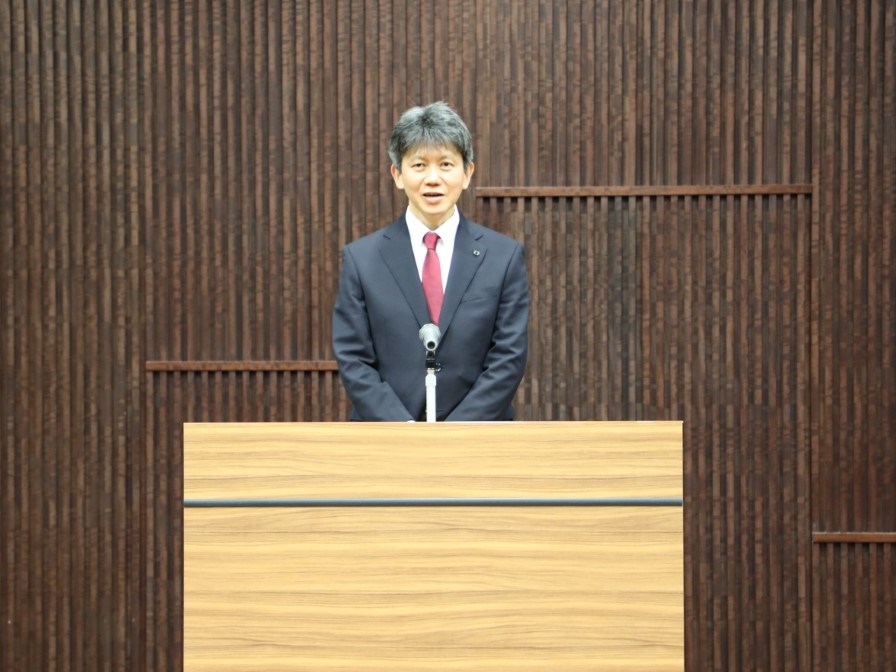
IDAC will be led by newly appointed Director and Professor Kozo TANAKA (Dept. of Molecular Oncology) starting April 1, 2023!
Greetings from the new Director of IDAC
“Now and Future” of IDAC
IDAC (formerly the Research Institute for Tuberculosis and Cancer), was established in 1941 for the purpose of overcoming tuberculosis and leprosy. Several decades later, the establishment was reorganized and renamed in 1993 as the Institute of Development, Aging and Cancer (IDAC) to reflect its commitment to Smart-Aging research. This was in response to the issues facing Japan, which has entered a super-aging society with the elderly population now approaching 30%. As a result, we conduct research from various aspects such as disease prevention, and we call the intellectual maturity of individuals and society “smart aging“ by wisely coping with changes from aging. To this end, we conduct multi-layered medical research, from gene and cell research using molecular biological techniques, individual-level research through animal experiments and human subject research. Our ultimate goal is the realization of a smart aging-society and we aim to become a world-leading research center for managing a super-aging society.
– Kozo TANAKA, Director
IDAC would like to deeply thank Dr. Ryuta KAWASHIMA for his commitment and leadership role as the Institute’s Director since 2014. Dr. KAWASHIMA will remain at IDAC as a Professor (Dept. of Functional Brain Imaging) while the Institute will be led by newly appointed Director and Professor Kozo TANAKA (Dept. of Molecular Oncology) starting April 1, 2023.
| Secretariat, Alumni Association, IDAC | |
| Date | Tuesday, 11 April 2023, 16:00~17:00 |
|---|---|
| Room | International Conference Room, Center for Smart-Aging Research,1F (IDAC), Web |
| Title | Biological thresholds to determine the timing and speed of aging |
| Speaker | Motoshi Hayano |
| Affiliation | Keio University, School of Medicine, Department of Neuropsychiatry |
| Organizer | Kozo Tanaka (Department of Molecular Oncology, ext 8491) |
| Abstract | While the DNA damage repair activity of SIRT6 plays a crucial role in rodent lifespan, the regulation of histone modifications and DNA methylation through Yamanaka factors (Oct4, Sox2, Klf4, and c-Myc) improves aging-associated phenotypes through the regulation of epigenetics in aging. To elucidate the threshold of the onset of aging and the epigenetics-mediated regulation of the aging speed, we have developed a mouse model, “ICE” mouse (for inducible changes in the epigenome), in which DNA damage is transiently induced in a tamoxifen-dependent manner (Kato et al., 2021 Dev. Cell; Yang and Hayano et al., Cell, in press). In ICE mice, “loss of identity” is observed, in which cell-specific gene expression and histone modifications are altered with age after DNA damage induction. In addition, induction of the aging phenotype in ICE mice requires a certain period of DNA damage, and the expression of histone/DNA modifiers and senescence genes is changed when the threshold is exceeded. In this seminar, we would like to discuss the molecular mechanisms that determine the “biological clock” and its diversity among species. |
| Secretariat, Alumni Association, IDAC | |
| Date | Friday, 10 March 2023, 16:00〜 |
|---|---|
| Room | International Conference Room, Center for Smart-Aging Research, 1F, (IDAC) |
| Title | Immunoregulatory receptors and drug discovery – What is my true heart of research? |
| Speaker | Professor Toshiyuki Takai |
| Affiliation | Department of Experimental Immunology, Institute of Development, Aging and Cancer, Tohoku University |
| Organizer | Mei-Tzu Su, Dept. Experimental Immunology ext 8504 |
| Abstract | During my years as a graduate student at Kyoto University, I was sticking to jobs for cDNA cloning of neuronal ion channel molecules. After a few career changes, I have been working at IDAC on the immunologic research for about 25 years, which is originated from my jobs as a visiting investigator during 1992–1993 at Sloan-Kettering Institute, USA. My research interest has been the elucidating the mechanism of immune regulation by activating and inhibitory immunoreceptors and its application to drug discovery. As you know well, the basis of the concept for cancer immunotherapy by inhibiting immune checkpoint is derived from achievements by many researchers dedicated to immunoregulatory receptors. Our lab is now considering that the utilization of immune checkpoint, namely inhibitory immunoreceptors, could be applicable also to the drug discovery toward autoimmune disease and neurodegenerative disease. Researchers will often be struggled due to various against situations and problems. In my talk today, I will grossly overview the 25-years investigations in our lab, and I want to think about what the true heart of researchers is, as words of cheers for young investigators of IDAC. |
| Secretariat, Alumni Association, IDAC | |
| Date | Tuesday, 7 March 2023, 16:00~17:00 |
|---|---|
| Room | International Conference Room, Center for Smart-Aging Research, 1F (IDAC), Web |
| Title | Novel strategy for priming immunogenicity through STING activation following MPS1 inhibition |
| Speaker | Shunsuke Kitajima |
| Affiliation | Department of Cell Biology, Japanese Foundation for Cancer Research |
| Organizer | Kozo Tanaka (Department of Molecular Oncology, ext 8491) |
| Abstract | Despite the impressive efficacy of PD-(L)1 blockade in lung cancer, specific genomic subsets promote intrinsic resistance. KRAS-LKB1 (KL) mutant lung cancers silence STING in an epigenetic manner, resulting in T cell exclusion and resistance to PD-(L)1 blockade. Here we discover that KL cells also minimize intracellular accumulation of 2’3’-cGAMP to further avoid downstream STING activation. An unbiased screen to co-opt this vulnerability reveals that transient MPS1 inhibition potently re-engages this pathway in KL cells via micronuclei generation. This strategy primarily impacts dividing cells, targets a major underlying mechanism of KL tumor immune escape, and involves pulse scheduling of inhibitors undergoing clinical development, facilitating translation into human trials. |
| Secretariat, Alumni Association, IDAC | |
| Date | Wednesday, 1 March 2023, 13:30~14:30 |
|---|---|
| Room | Online (Zoom) |
| Title | Diffusion MRI by Machine Learning |
| Speaker | Yoshitaka Masutani Ph.D |
| Affiliation | Medical Image Computation Lab, Division of Health Sciences, Tohoku University Graduate School of Medicine |
| Organizer | Yasuyuki Taki (Dept. of Aging Research and Geriatric Medicine・ext 8559) Yasuko Tatewaki (Dept. of Aging Research and Geriatric Medicine・ext 8559) |
| Abstract | In this talk, the basics and recent developments in quantitative acquisition of the structural and functional features in the living bodies by diffusion MRI (dMRI) are presented. First, various signal models such as DTI, DKI, and NODDI with their classification from the viewpoint of parameter inference methods are introduced. Next, mathematical generalizations and methodologies in the parameter inference are presented including the development from conventional fitting to recent machine learning approaches. In addition, an original technique called synthetic Q-space learning is described with its advantages and disadvantages by showing application results in various signal models. Finally, future prospects for dMRI parameter inference are discussed from the aspects of imaging, modeling and simulation. The main content of this seminar is available in a review paper by the speaker [1]. [1] Masutani Y, Recent Advances in Parameter Inference for Diffusion MRI Signal Models, Magn Reson Med Sci 21(1): 132-147, 2022 |
| Secretariat, Alumni Association, IDAC | |
| Date | Friday, 17 February 2023, 16:00~17:00 |
|---|---|
| Room | 7th Floor, Seminar Room 1,IDAC Center for Basic Aging Research |
| Title | Overview and Perspective of Pharmacology Research in Oncology |
| Speaker | Kentaro Ito |
| Affiliation | Oncology Research Lab II, R&D division, Daiichi Sankyo Co., Ltd. |
| Organizer | Kenji Iemura, Department of Molecular Oncology・ext 8490 |
| Abstract | Understanding on tumor biology is astonishingly deepened and expanded by rapid evolution in research technologies. Moreover, clinical success of immunotherapy such as anti–PD-1 antibody proves the importance of immunity in tumor biology and has been changing the standard of care in oncology field. The presenter confronts such a drastic change as an oncology researcher in a pharmaceutical company. In this seminar, we will grasp the overview of R&D in a pharmaceutical company and discuss challenges in drug discovery based on the trends and his experience in target discovery research. The seminar may also provide clues in career development as a researcher in pharmaceutical company. |
IDAC’s 159th Biannual Meeting (an all-English event), will take place on February 10, 2023 from 1PM onwards via hybrid format: International conference room on the 1st floor of SA Building and online.
For more details, please click to see the program poster.
| Secretariat, Alumni Association, IDAC | |
| Date | Thursday, 26 January 2023, 13:30~15:00 |
|---|---|
| Room | Web |
| Title | Zinc homeostasis and proteostasis in cells |
| Speaker | Kenji Inaba Ph.D |
| Affiliation | Institute of Multidisciplinary Research for Advanced Materials |
| Organizer | Hitoshi Yamagata, Dept. of Aging Research and Geriatric Medicine・ext 8559 |
| Abstract | In recent years, we have been working on cellular protein quality control systems governed by chemical parameters such as redox, pH and metal ions, and discovered that zinc ions play a particular role for proteostasis at the ER-Golgi interface. To understand molecular mechanisms of the zinc-dependent protein quality control, we have developed a method for quantitative zinc imaging in each intracellular organelle and determined a high-resolution cryo-EM structure of one of the zinc transporters that control zinc concentration in the Golgi apparatus. In this lecture, I plan to present our recent findings of the close correlation between zinc homeostasis and proteostasis, and also introduce some diseases caused by the disruption of intracellular zinc homeostasis. |
| Secretariat, Alumni Association, IDAC | |
| Date | Wednesday, 21 December 2022, 16:00~17:00 |
|---|---|
| Room | 7th Floor, Seminar Room 1, IDAC Center for Basic Aging Research |
| Title | New frontiers in regulation of gene expression: the role of CCR4-NOT |
| Speaker | Tadashi Yamamoto |
| Affiliation | Cell Signal Unit, Okinawa Institute of Science and Technology Graduate University |
| Organizer | Kenji Iemura, Department of Molecular Oncology・ext 8490 |
| Secretariat, Alumni Association, IDAC | |
| Date | Monday, 5 December 2022, 18:00~19:30 |
|---|---|
| Room | 7th Floor, Seminar Room 1,IDAC Center for Basic Aging Research |
| Title | QUO VADIS DUOX? |
| Speaker | Albert van der Vliet, Ph.D. |
| Affiliation | Department of Pathology and Laboratory Medicine, Larner College of Medicine, The University of Vermont |
| Organizer | Hozumi Motohashi (Dept. Gene Expression Regulation・ext8550) |
| Abstract | DUOX1 is a homolog of the NADPH oxidase family that is prominently expressed in epithelial cells at mucosal surfaces, including the lung. Our prior studies showed that DUOX1 participates in airway epithelial host defense against various environmental triggers, particularly by promoting epithelial release of alarmins such as interleukin-33, and by activation of type 2 immune responses that help improve epithelial regeneration and mucociliary clearance of pathogens. These processes involve DUOX1-dependent production of H2O2 and subsequent redox-dependent activation of tyrosine kinase signaling involving Src family kinases and EGFR signaling. Airway DUOX1 is increased in subjects with allergic asthma, and studies of genetic deletion or pharmacological inhibition of DUOX1 indicate their ability to prevent or reverse various key symptoms of allergic airway inflammation, such as type 2 inflammation, mucus hyperplasia, and airway remodeling, suggesting DUOX1 as a useful therapeutic target. In current ongoing work, we are extending these observations in the context of comorbities that may worsen asthma, such as obesity and aging. Intriguingly, we observed that airway DUOX1 is decreased during aging, which is associated with impaired innate epithelial type 2 responses upon injury, and suggest that such DUOX1 decline may contribute to increased susceptibility to age-related diseases such as chronic obstructive pulmonary disease or pulmonary fibrosis. In this presentation, I will briefly summarize the history of discovery of NADPH oxidases such as DUOX1, and the varying roles of DUOX1 in lung biology and pathology, which highlight some unanticipated twists and potential expanded therapeutic opportunities of DUOX1 targeting. |
IDAC will be holding a “Smart Aging Citizen Seminar” at Tohoku University’s Katahira Campus on November 26th (Saturday) with the following details:
To spend the 100-year life era lively and energetically
~Tohoku University Smart Aging Citizen Seminar~
Date: November 26 (Saturday) from 14:00-15:30 (reception begins from 13:30-14:00)
Venue: Tohoku University’s Katahira Campus Extension Education Research Building, 6th Floor, Lecture Room A
Organizer: Tohoku University Smart-Aging Research Center (S.A.R.C.), Tohoku University Knowledgecast Co., Ltd. in cooperation with Curves Japan Co., Ltd.
| Secretariat, Alumni Association, IDAC | |
| Date | Tuesday, 1 November 2022,16:00〜17:00 |
|---|---|
| Room | 7th Floor, Seminar Room 1,IDAC Center for Basic Aging Research |
| Title | The plastic change of aneuploidization contributes to malignant properties in cancers. |
| Speaker | Minji Jo |
| Affiliation | Division of Experimental Pathology, Cancer Institute, Japanese Foundation for Cancer Research (JFCR) |
| Organizer | Kenji Iemura, Department of Molecular Oncology・ext 8490 |
| Abstract | Chromosome segregation errors generate cells with an abnormal number of chromosomes, i.e., aneuploidy. This is a common feature of cancers that is thought to correlate with drug resistance and poor prognosis. We previously assessed the ploidy of gastric cancer cells and unexpectedly found the extent of aneuploidization fluctuates during disease progression. This observation led us to hypothesize that the fluctuating aneuploidy level, instead of staying at high or low levels, might associate with the acquisition of malignant properties. To address this, we inoculated cancer stem cell clones with different ploidy statuses to mice. The results recapitulated what we saw in gastric cancers and, intriguingly, tumors that were formed in mice revealed characteristic malignant features depending on its aneuploidy levels. In this talk, I will share the latest datasets and also discuss the possibility that the mitotic kinase Aurora B might underlie the ploidy fluctuation, contributing to the acquisition of diverse malignant phenotypes in cancers. |
| Secretariat, Alumni Association, IDAC | |
| Date | Wednesday, 26 October 2022, 15:00~16:00 |
|---|---|
| Room | 6F seminar room, Smart Aging Building, IDAC |
| Title | Promoting Physical Activity for Elderly People with Immersive Virtual Reality (IVR). |
| Speaker | Professor. Jérôme DINET |
| Affiliation | Psychology and Neuroscience lab, Université de Lorraine, France |
| Organizer | Kawashima Ryuta (Department of functional brain imaging・ext 7988) Nouchi Rui (Department of cognitive health science・ext 8952) |
| Abstract | Physical and social activities should be included in an efficient e-coaching for older adults and immersive virtual reality (IVR) is efficient if behavioral changes are transferred to the real physical world. In an experiment con-ducted with 42 older adults (63-85 years-old), participants were asked to interact with a specific immersive virtual reality (IVR) daily for 4 months in their homes, at least 15 minutes per day. Results demonstrate several positive impacts related to the use of the IVR (decrease of weight, decrease of waist circumference, number of steps outside) even if the time spent to use this IVR system decreases. So, the transfer from the IVR to the real world is very encouraging. |
| Secretariat, Alumni Association, IDAC | |
| Date | Thursday, 1 September 2022, 15:00~16:00 |
|---|---|
| Room | Smart-Aging building 4F Seminar Room, Web |
| Title | MR-phase information for clinical application |
| Speaker | Tetsuya YONEDA Ph.D |
| Affiliation | Department of Medical Imaging Sciences, Faculty of Life Sciences, Kumamoto University |
| Organizer | Yasuyuki Taki (Dept. of Aging Research and Geriatric Medicine・ext8559) Yasuko Tatewaki (Dept. of Aging Research and Geriatric Medicine・ext8559) |
| Abstract | MR-phase image is an elemental component of MRI image. Therefore, MRI essentially gives us phase image and we can use it as clinical information. In this seminar, we learn basic knowledges and theoretical backgrounds of phase information so as to properly use phase image for clinical cases. |
| Secretariat, Alumni Association, IDAC | |
| Date | Tuesday, 19 July 2022,15:00〜 |
|---|---|
| Room | IDAC- Smart Aging Research Center, Seminar Room 2F |
| Title | At the root of bodily self-consciousness |
| Speaker | Lorenzo Pia, Associate Professor |
| Affiliation | Department of Psychology, University of Turin (Italy) |
| Organizer | Dalila Burin (Smart Ageing International Research Center, Ext. 8585 |
| Abstract | At present, there is a large consensus that human sense of agency (i.e., “this action is due to my own will”) is rooted in a variety of internal efferent signals arising within the motor system (e.g., motor intentions, planning, sensorimotor predictions and so on). However, recent neuroscientific evidence suggests that that also body-related afferent signals subserving body ownership (i.e., “this body is mine”) might have a role per se in building up human conscious awareness of willed actions. In the present seminar, I will present data from both brain damaged-patients and intact brain functioning supporting this idea. Then, I will argue that, whenever required by the context, body ownership per se can act on agency attribution (i.e., independently from efferent signals). This, in turn, indicates that a unitary and coherent subjective experience of willed actions (i.e., “this willed action is being realized by my own body”) requires both awareness of being an agent and of owning the body. |
IDAC’s 158th Biannual Meeting (an all-English event), will take place on July 15, 2022 from 1PM onwards via ZOOM.
For more details, please click to see the poster.
Recruitment Notice for Faculty Position at Institute of Development, Aging and Cancer, Tohoku University
Position Available: Assistant Professor (1 position)
Department: Institute of Development, Aging and Cancer, Tohoku University, Center for Environmental Response and Aging, Laboratory of Nucleic Acid Modifications and Damage Response
Job Description: The candidate will be involved in the creation, supply, and analysis of aging mice under environmental stress at the Center for Environmental Response and Aging. Additionally, the candidate will engage in basic research on the relationship between genomic instability, cancer and aging.
Qualification: Candidates should hold a PhD or be expected to obtain one by the time of appointment, with a background in a science-related field.
Expected Start Date: From April 1, 2025, or later (negotiable)
Condition:
(1) Salary: Based on Tohoku University’s employment regulations, salary will be determined according to experience. The annual salary system applies, starting at approximately 4,320,000 JPY. Other allowances, such as commuting allowance, may be provided.
(2) Employment Status: Full-time
(3) Term: Until March 31, 2026 (renewable)
(4) Working Hours: Discretionary labor system for professional work. Basic working hours are from 8:30 AM to 5:15 PM, subject to individual discretion.
(5) Holidays: Weekends, public holidays, and New Year holidays (December 29 to January 3)
(6) Social Insurance: Ministry of Education, Culture, Sports, Science and Technology Mutual Aid Association, employment insurance, and workers’ compensation insurance.
Other conditions follow Tohoku University’s employment regulations. Tohoku University Regulations
Application Documents:
(1) CV (Tohoku University format, with a photo attached)
(2) List of published papers and conference presentations
(3) Summary of previous research (within one A4 page)
(4) Contact information for 1-2 referees who can provide opinions on the applicant (e.g., email addresses)
*Documents (2)-(4) are free format
(CV format should be downloaded here.)
Application Deadline: Applications must arrive by December 27, 2024 (Friday)
Submission: Please send the PDF files of the required documents (1) to (4) via email to kozo.tanaka.d2*tohoku.ac.jp (replace * to @). Note that application documents will not be returned.
Contact Information:
o Contact Person: Kozo Tanaka, Laboratory of Nucleic Acid Modifications and Damage Response, Center for Environmental Response and Aging, Institute of Development, Aging and Cancer, Tohoku University
o Email: kozo.tanaka.d2*tohoku.ac.jp (replace * to @)
o Phone: 022-717-8491
Remarks:
o Applicants may be requested to give a presentation during the selection process.
o Tohoku University promotes activities to enhance diversity, equity, and inclusion (DEI) and encourages applications from diverse candidates. Tohoku University DEI Promotion Statement
o In accordance with the Equal Employment Opportunity Law for Men and Women, Article 8, women will be given preference if they have equivalent qualifications, as part of efforts to improve the employment rate of female faculty members.
o Tohoku University has established guidelines to respect diverse genders in academic, research, and professional activities. Tohoku University Gender Diversity Guidelines
o Tohoku University offers childcare facilities, including the Kawauchi Keyaki Nursery School (capacity: 22), Aobayama Midori Nursery School (capacity: 116), and Hoshinoko Nursery School (capacity: 120) for hospital staff. There are also childcare rooms for mildly ill children and post-illness children available for all university staff.
o Details on support for work-life balance and research support are available on the following websites:
Diversity, Equity & Inclusion Promotion Center
Human Resources Planning Division
RECRUITEMENT FOR THIS POSITION IS CLOSED
Recruitment Notice for Faculty Position at Institute of Development, Aging and Cancer, Tohoku University
Position Available: Assistant Professor (1 position)
Department: Institute of Development, Aging and Cancer, Tohoku University, Center for Environmental Response and Aging, Laboratory of Nucleic Acid Modifications and Damage Response
Job Description: The candidate will be involved in the creation, supply, and analysis of aging mice under environmental stress at the Center for Environmental Response and Aging. Additionally, the candidate will engage in basic research on the relationship between genomic instability, cancer and aging.
Qualification: Candidates should hold a PhD or be expected to obtain one by the time of appointment, with a background in a science-related field.
Expected Start Date: From October 1, 2024, or later (negotiable)
Condition:
(1) Salary: Based on Tohoku University’s employment regulations, salary will be determined according to experience. The annual salary system applies, starting at approximately 3,360,000 JPY. Other allowances, such as commuting allowance, may be provided.
(2) Employment Status: Full-time
(3) Term: Until March 31, 2025 (renewable)
(4) Working Hours: Discretionary labor system for professional work. Basic working hours are from 8:30 AM to 5:15 PM, subject to individual discretion.
(5) Holidays: Weekends, public holidays, and New Year holidays (December 29 to January 3)
(6) Social Insurance: Ministry of Education, Culture, Sports, Science and Technology Mutual Aid Association, employment insurance, and workers’ compensation insurance.
Other conditions follow Tohoku University’s employment regulations. Tohoku University Regulations
Application Documents:
(1) CV (Tohoku University format, with a photo attached)
(2) List of published papers and conference presentations
(3) Summary of previous research (within one A4 page)
(4) Contact information for 1-2 referees who can provide opinions on the applicant (e.g., email addresses)
*Documents (2)-(4) are free format
(CV format should be downloaded here.)
Application Deadline: Applications must arrive by July 31, 2024 (Wednesday)
Submission: Please send the PDF files of the required documents (1) to (4) via email to kozo.tanaka.d2*tohoku.ac.jp (replace * to @). Note that application documents will not be returned.
Contact Information:
o Contact Person: Kozo Tanaka, Laboratory of Nucleic Acid Modifications and Damage Response, Center for Environmental Response and Aging, Institute of Development, Aging and Cancer, Tohoku University
o Email: kozo.tanaka.d2*tohoku.ac.jp (replace * to @)
o Phone: 022-717-8491
Remarks:
o Applicants may be requested to give a presentation during the selection process.
o Tohoku University promotes activities to enhance diversity, equity, and inclusion (DEI) and encourages applications from diverse candidates. Tohoku University DEI Promotion Statement
o In accordance with the Equal Employment Opportunity Law for Men and Women, Article 8, women will be given preference if they have equivalent qualifications, as part of efforts to improve the employment rate of female faculty members.
o Tohoku University has established guidelines to respect diverse genders in academic, research, and professional activities. Tohoku University Gender Diversity Guidelines
o Tohoku University offers childcare facilities, including the Kawauchi Keyaki Nursery School (capacity: 22), Aobayama Midori Nursery School (capacity: 116), and Hoshinoko Nursery School (capacity: 120) for hospital staff. There are also childcare rooms for mildly ill children and post-illness children available for all university staff.
o Details on support for work-life balance and research support are available on the following websites:
Diversity, Equity & Inclusion Promotion Center
Human Resources Planning Division
Number of positions: 1 professor
Application Deadline: 27 September 2024(Japan Standard Time)
Where to submit documents and for inquiries: General Affairs Section, Institute of Development, Aging and Cancer, Tohoku University
Tel: 022-717-8442
E-mail: application*idac.tohoku.ac.jp (replace * with @)
RECRUITEMENT FOR THIS POSITION IS CLOSED
Institute of Development, Aging and Cancer, Tohoku University Faculty Positions
Summary: The Institute of Development, Aging and Cancer, Tohoku University, invites international applications for two tenure-track associate professorships. The Institute of Development, Aging and Cancer (IDAC) conducts multilevel medical research to elucidate the fundamental mechanisms of aging, from birth to development, maturation, aging and death, ranging from genetic and cellular research using molecular biological techniques to individual-level research using animal experiments and research on human subjects. In this call for applications, we are looking for researchers who will work on elucidating the basic mechanisms of aging.
Position: Tenure-track associate professor
Number of positions: Two positions for associate professor
Starting date: After appointment, 1 April 2024 or as soon as possible after that date.
Type of employment: Full-time (tenure-track).
A tenured position may be appointed within five years following review by the Tenure Qualification Review Committee.
Qualifications: Applicants must hold a doctoral degree.
Compensation: In accordance with the regulations on employment of Tohoku University staff and other rules and regulations.
Deadline for applications: 30 September, 2023 (Japan Standard Time)
Documents to be submitted (in Japanese or English):
1. CV (CV format should be downloaded here)
2. A summary of your research to date (free style, figures and tables allowed, no more than 2 pages of A4 paper)
3. Future research plans and long-term vision (free style, figures/tables allowed, no more than 2 pages of A4 paper)
4. Copies of key publications (not more than 10), and the outline and appeal points of the three publications you would like to promote in particular (about 200 words each).
Submission Method:
Please read the following instructions carefully and send your application to the following email address: application*idac.tohoku.ac.jp (replace * with @)
1. All files are in PDF format in principle and file names should include the contents and the applicant’s name (e.g. 1_CV_KAREIKEN_TARO).
2. Please compress all files into a single file in ZIP format and send it as an attachment to an email with the file name “‘IDAC_Faculty Application_Applicant’s name “. The subject line of the email should be the same as the file name.
3. The maximum file size for attachments is 25MB. If the maximum size is exceeded, please contact us for additional upload instructions.
4. Once submitted, you will shortly receive an email confirming receipt of your documents. If you do not receive an email, please contact us.
5. Contact information:
Institute of Development, Aging and Cancer (IDAC), Tohoku University
General Affairs Section
Email: application*idac.tohoku.ac.jp (replace * with @)
Selection method: Document review and interview (web or face-to-face).
Notes:
・Tohoku University promotes activities to enhance Diversity, Equity & Inclusion (DEI) and welcomes applications from diverse individuals. Tohoku University DEI Affirmative Action Statement WEB Page http://tumug.tohoku.ac.jp/en/
・As a measure to improve the enrolment rate of female faculty members in accordance with Article 8 of the Act on Ensuring Equal Opportunity and Treatment of Men and Women in Employment, etc., women will be given priority in hiring if their abilities required for the job are deemed equal based on a fair evaluation.
・Tohoku University has the Kawauchi Keyaki Nursery School (capacity: 30) and the Aobayama Midori Nursery School (capacity: 116), which are available to all university staff and faculty members providing the largest on-site childcare facilities among national university childcare facilities in Japan.
There is also a nursery for children with minor illnesses and those recovering from illnesses at the University Hospital, which is available to all University staff and faculty members.
・Further details of the University’s support for work-life balance, research support and other gender equality initiatives can be found at the following URL WEB page of the Centre for the Promotion of Gender Equality http://www.tumug.tohoku.ac.jp/en/
IDAC will begin public recruitment for Joint Use & Joint Research according to the guidelines below, so please feel free to apply.
[Detailed URL]
[Contact]
Research Promotion Section, IDAC
Tel: 022-717-8445
E-mail: ida-sen@grp.tohoku.ac.jp
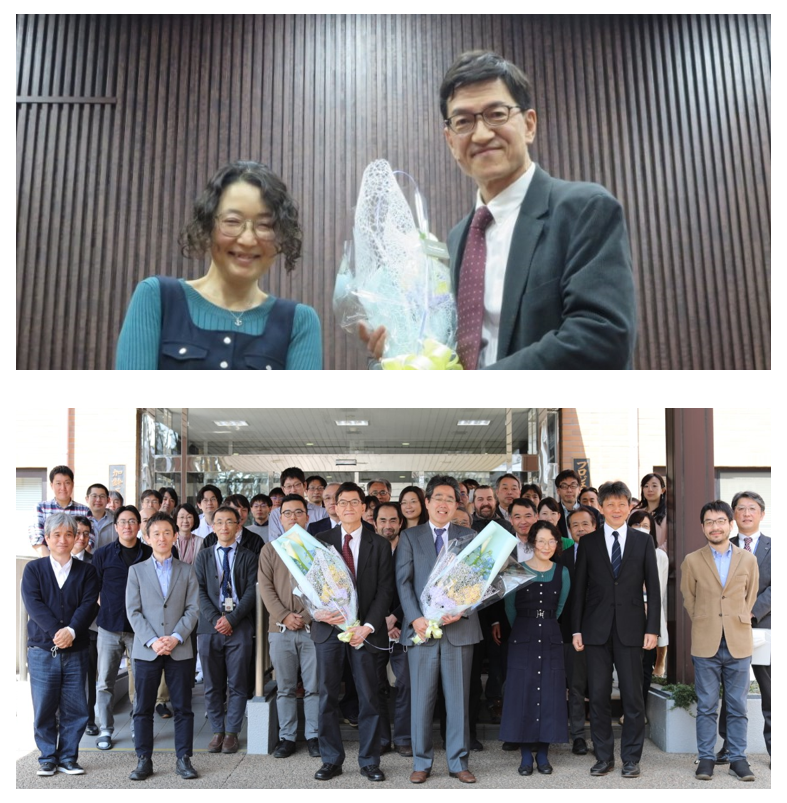
IDAC’s Professor Toshiyuki TAKAI from the Department of Experimental Immunology has retired from his tenure as Professor from the Institute of Development, Aging and Cancer (IDAC) as of March 31, 2023.
Professor TAKAI will remain at IDAC as a Professor (Specially appointed for research) at the Department of Experimental Immunology beginning April 1, 2023
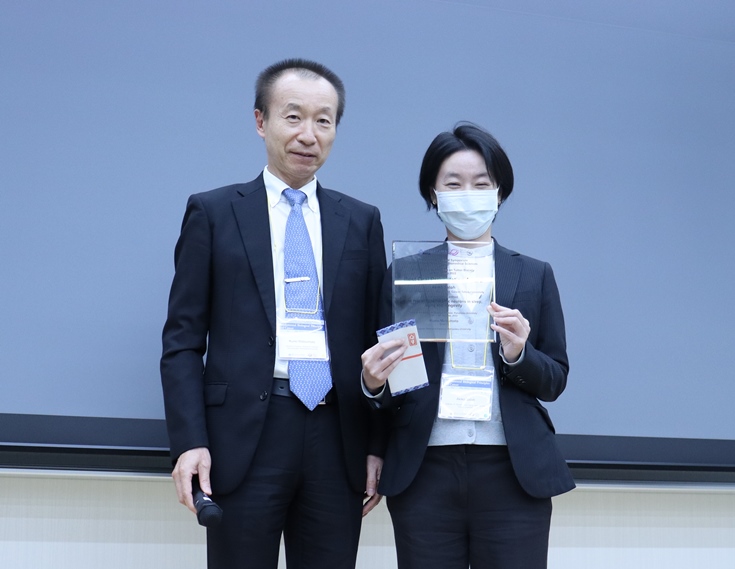
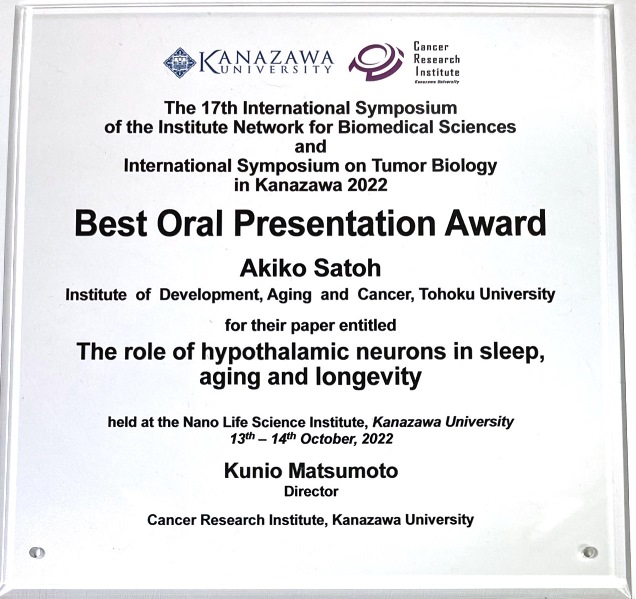
CONGRATULATIONS to IDAC’s Associate Professor Akiko SATOH for winning the the “Best Oral Presentation Award” at the 17th International Symposium of the Institute Network for Biomedical Sciences and International Symposium on Tumor Biology in Kanazawa 2022.
Associate Professor Akiko SATOH received the “Best Oral Presentation Award” for her presentation titled “The role of hypothalamic neurons in sleep, aging and longevity”.
The Institute Network for Biomedical Sciences and International Symposium was attended by 12 affiliated research institutes in life and medical sciences with the aim of clearly disseminating the efforts and research results to society. This event is held once a year and the 17th International Symposium of the Institute Network for Biomedical Sciences and International Symposium on Tumor Biology was held on October 13-14, 2022 at the Cancer Research Institute, Kanazawa University.
[Contact]
Dept. of Integrated Physiology, IDAC, Tohoku University
TEL: 022-717-8491
Title: Researchers Reveal the Role of the CHAMP1 Gene in Neuronal Development
Body: Intellectual disability affects roughly 2-3% of the world’s population. Scientists understand the genes related to intellectual disability, but how the mutations of these genes cause this developmental disorder remains largely unknown. As a result, effective therapeutic interventions are lacking.
Now, a research group led by two Tohoku University researchers has uncovered the role of CHAMP1—a gene whose mutations are associated with intellectual disability—in neuronal development.
Details of their research were published in the journal Brain Communications on August 30, 2022.
Kozo Tanaka from the Institute of Development, Aging and Cancer, and Noriko Osumi from the Graduate School of Medicine and their group studied mice with the CHAMP1 gene ‘knocked out,’ where one or both of the genes from father and mother were inactivated.
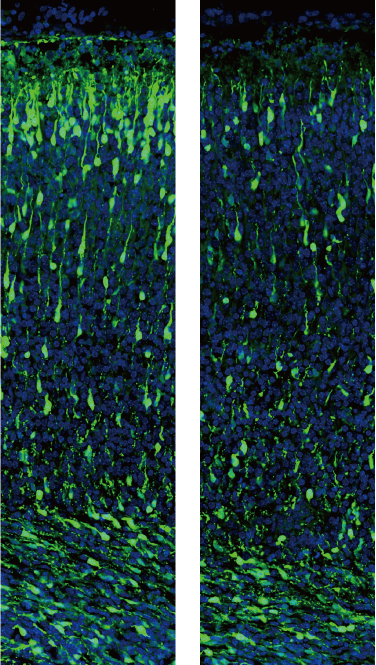
When both of the CHAMP1 genes were deleted, mice died soon after birth. And despite no apparent brain structure abnormalities, the researchers found that neural cell migration towards the brain surface was delayed, indicating a delay in neuronal development.
When a single CHAMP1 gene was lost, mice demonstrated slight memory defects, impaired social skills, and depression-like behavior. These mild behavioral problems resembled some aspects of individuals with CHAMP1 mutations.
Whilst many genes are related to intellectual disability, CHAMP1 is one of the most commonly unearthed mutations, with more that 100 cases worldwide.
“We need further research of CHAMP1 so we can understand how intellectual disability occurs, and to ultimately find a way to treat it,” said Tanaka.
Publication Details:
Title: Deficiency of CHAMP1, a gene related to intellectual disability, causes impaired neuronal development and a mild behavioral phenotype
Authors: Masayoshi Nagai, Kenji Iemura, Takako Kikkawa, Sharmin Naher, Satoko Hattori, Hideo Hagihara, Koh-ichi Nagata, Hayato Anzawa, Risa Kugisaki, Hideki Wanibuchi, Takaya Abe, Kenichi Inoue, Kengo Kinoshita, Tsuyoshi Miyakawa, Noriko Osumi, Kozo Tanaka
Journal: Brain Communications
DOI: 10.1093/braincomms/fcac220
Embargo date: 2022/8/30
Contact:
Name: Kozo Tanaka
Affiliation: Institute of Development, Aging and Cancer, Tohoku Univeristy
Email: kozo.tanaka.d2@tohoku.ac.jp
Faculty / Research Center / Lab website URL:
http://www2.idac.tohoku.ac.jp/dep/molonc/pg40.html
Image:
[Image1]
Caption: Immunofluorescence images of fetal mice brain sections show a delay in the migration of neural cells (green) towards the surface of the cerebral cortex (upper) when expression of CHAMP1 is suppressed (right) compared with a normal condition (left).
License: CC BY
Credit: Nagai et al
Restriction: Reporters may use freely these materials in news coverage with appropriate credit information.
Collaborating institutions:
Did an organization fund this?
JSPS KAKENHI (24370078, 19K22410)
MEXT KAKENHI (26116501, 16H01296, 16H06276 (AdAMS))
MEXT Grant-in-Aid for Scientific Research on Innovative Areas (16H06530)
Grant-in-Aid for JSPS Research Fellow (17J02608)
Grant Program Research from the Division for International Advanced Research and Education, Tohoku University
Grant-in-Aid for Joint Research by Young Researchers, Tohoku University Graduate School of Medicine
Ensemble Grants for Early Career Researchers, Tohoku University
Takeda Science Foundation
Princess Takamatsu Cancer Research Fund (10-24210)
☒ Alert funders when press release is accepted to EurekAlert
Keywords :
gen, disease, mouse, brain
Primary keyword:
Biology
| Secretariat, Alumni Association, IDAC | |
| Date | Tuesday, 14 June 2022, 15:30~16:30 |
|---|---|
| Room | 7th Floor, Seminar Room 1,IDAC Center for Basic Aging Research |
| Title | RNA-mediated immunometabolic regulation |
| Speaker | Takahisa Nakamura |
| Affiliation | Dept. Metabolic Bioregulation/Cincinnati Children’s Hospital |
| Organizer | Hozumi Motohashi (Dept. Gene Expression Regulation・ext8550) |
| Secretariat, Alumni Association, IDAC | |
| Date | Wednesday, 11 May 2022, 17:00~ |
|---|---|
| Room | 7th Floor, Seminar Room 1,IDAC Center for Basic Aging Research |
| Title | Functional Validation of Somatic Copy Number Alteration (SCNA) in KRAS driver mutation Lung Adenocarcinoma |
| Speaker | Dr. Nagano, Ai |
| Affiliation | Cancer Institute, University College London |
| Organizer | Ogasawara, Koetsu (Department of Immunobiology・ext 8579) |
| Abstract | Introduction: The somatic copy number deletions on chr9p21 and chr3p21 are prevalent in KRAS driver mutation lung adenocarcinoma (LUAD). While recent genomic studies catalogued the significance of somatic copy number alterations (SCNA) in cancer cohorts, the functions of each copy number segment are still unknown. Material and Method: Here, we developed a new clone tracking system, COBALTseq (CRISPR-mediated copy number editing with barcoded clone tracking by sequencing) to quantify one of the functions, the cell growth advancement. We designed the target vectors of chr9p21 and chr3p21 using lentivirus to introduce two DNA double-strand breaks to the junctions of each segment. Using this approach, we measured the cell growth advantage on four KRAS driver LUAD cell lines, NCI-H358 and A549. Result: We tracked on average 200 clones edited with SCNA target vectors. The significant increase of cell growth was observed on chr9p21 deletion on NCI-H358 and on chr3p21 on A549 cell line. Conclusion: In conclusion, a novel approach, COBALTseq demonstrated the quantitative cell growth advancement from initiating the cancer driving genomic alterations. Despite the low genome-editing efficiency of 2-3% on SCNA region, the main strength of this approach is to detect the cell growth advantage by clone tracking which allows us to statistically focus on a small proportion of successfully edited clones within a population. |
| Secretariat, Alumni Association, IDAC | |
| Date | Wednesday, 13 October 2021,16:00~17:00 |
|---|---|
| Room | Center for Smart Aging Research 1F, IDAC |
| Title | Suppression of Selfish Centromeres |
| Speaker | KUMON, Tomohiro |
| Affiliation | University of Pennsylvania |
| Organizer | Kenji.Iemura (Department of Molecular Oncology・ext 8450) |
| Abstract | Selfish centromeres are the example of repetitive DNA that selfishly increases the chance of inheritance at the expense of the host fitness. Evolutionary arms race between selfish genetic elements and their suppressor mechanisms drives their rapid evolution. Despite the universal requirement for faithful chromosome segregation, eukaryotic centromeres are rapidly evolving. Evolutionary theory suggests that centromere proteins evolve to suppress costs of selfish centromere DNA, but the suppression mechanism remains unclear. In hybrid mouse models with genetically different maternal and paternal centromeres, selfish centromere DNA exploits a kinetochore pathway to recruit microtubule-destabilizing proteins that act as drive effectors. We show that such functional differences are suppressed by a parallel pathway for effector recruitment by heterochromatin, which is similar between centromeres in this system. We propose that centromere proteins have recurrently evolved to minimize the kinetochore pathway, which is exploited by selfish DNA, relative to the heterochromatin pathway that equalizes centromeres, while maintaining essential functions. 参考文献:Kumon, T. et al. Parallel pathways for recruiting effector proteins determine centromere drive and suppression. Cell 184, 4904-4918.e11 (2021) |
IDAC’s 156th Biannual Meeting (an all-English event), will take place on July 16 from 1PM at the Center for Smart-Aging Research Building, 1st Floor OR online via ZOOM.
For more details, please click to see the poster.
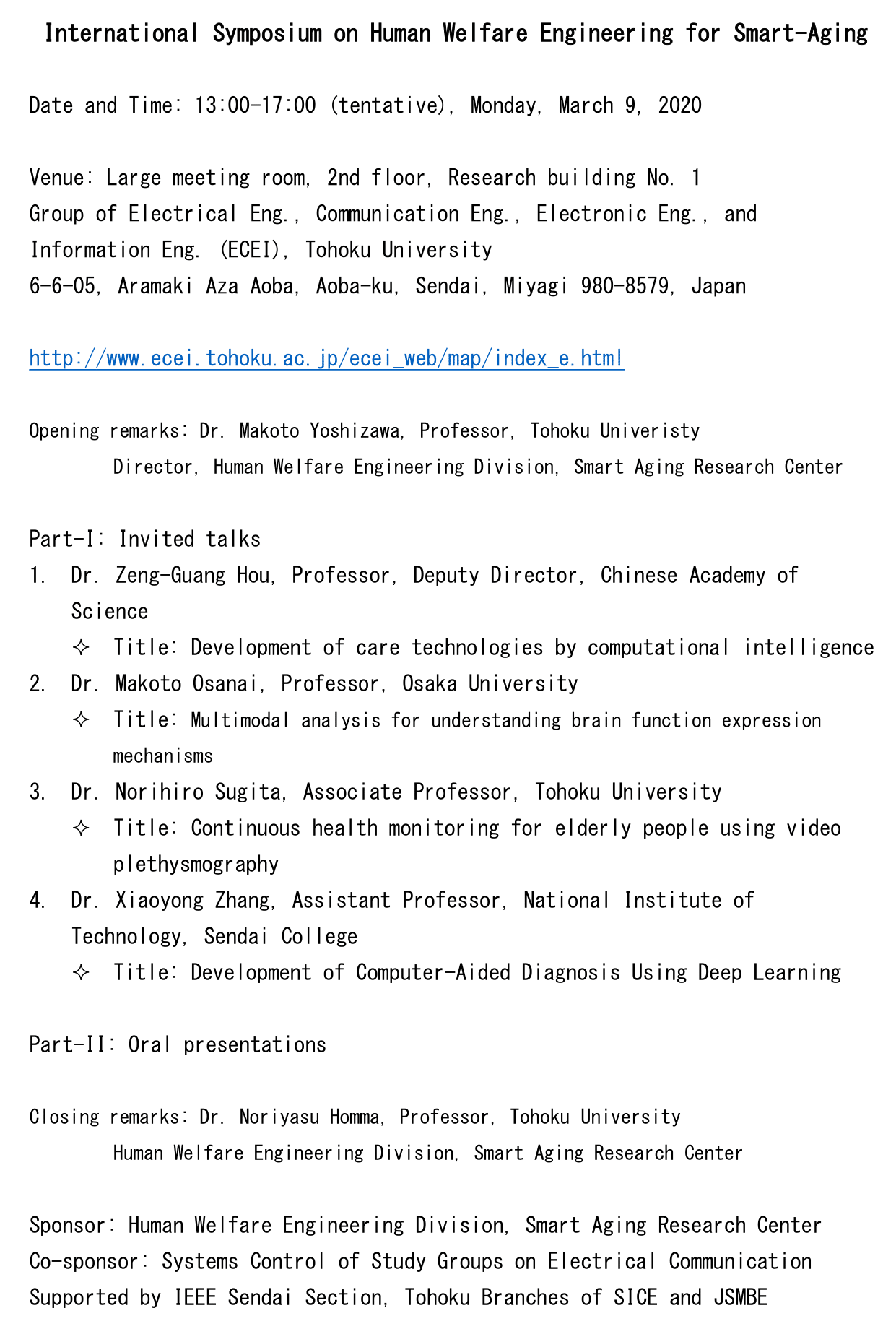
The Human Welfare Engineering Division of the Smart Aging Research Center (S.A.R.C.) will hold the “International Symposium on Human Welfare Engineering for Smart-Aging” on March 9 (Monday), 2020, from 1:00 – 5:00 PM at the 2nd floor Large Meeting Room of Research Building #1 (Aobayama Campus).
Please check the attached file for more details and we look forward to having you join us!
Campus Map:
http://www.ecei.tohoku.ac.jp/ecei_web/map/index_e.html
Program:
CONTACT:
Smart-Aging Research Center (S.A.R.C.)
Institute of Development, Aging and Cancer
Tohoku University
980-8575
4-1 Seiryo-machi, Aoba-ku, Sendai-shi
Phone number: 022-717-8582
E-mail: sac-office@grp.tohoku.ac.jp
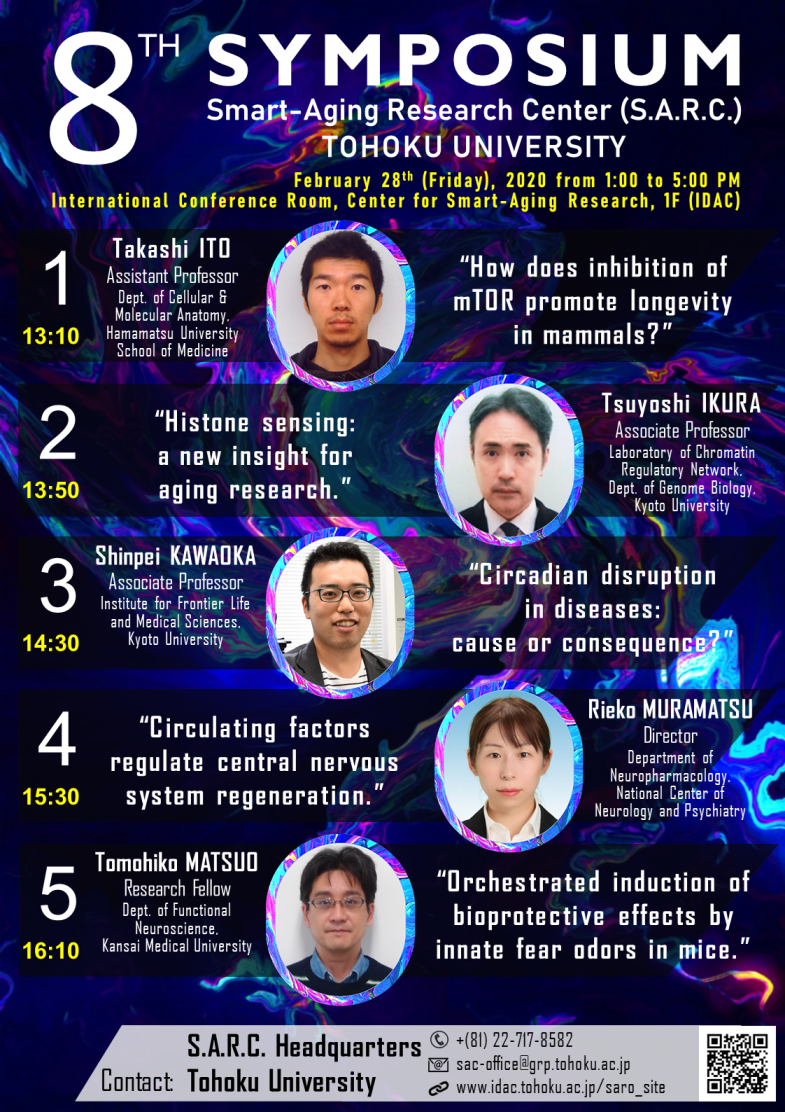
S.A.R.C.’s 8th Symposium on Dementia Prevention will be held at IDAC on February 28 (Friday), from 1:00 PM – 5:00 PM at the Smart-Aging International Conference Room.
Tohoku University’s Smart-Aging Research Center (S.A.R.C.) was established in 2017 to focus on promoting research that is aimed at realizing healthy longevity by conducting research for the prevention and treatment of age-related diseases such as dementia using a multi-tier approach from basic research to medical, ergonomics and social science. Furthermore, S.A.R.C. conducts interdisciplinary activities not only in basic research, but also in social implementation through industry-academic collaborations and ventures.
In this symposium, five lectures will take place from up and coming researchers that are actively involved in basic research from various life science fields, both locally and globally, with a focus on providing practical applications for a better and healthier society.
To visit S.A.R.C.’s homepage, click on: S.A.R.C.
For more details on S.A.R.C.’s 8th Symposium, please see the poster below:


![[POSTPONED] International Symposium on Human Welfare Engineering for Smart-Aging](https://www.idac.tohoku.ac.jp/site/wp-content/uploads/2016/02/Screenshot-366-e1687842814279.png)