
| Professor | Kozo TANAKA |
| Assistant Professor | Kenji IEMURA |
| Assistant Professor | Kinue KUNIYASU |

The Origin of Genomic Instability and its Relevance to Cancer and Aging
Our body comprises around thirty-seven trillion cells, all of which originate from a single fertilized egg. Each cell faithfully inherits genetic information through the cooperation of a number of elaborate mechanisms. By contrast, most cancer cells exhibit chromosomal abnormalities and genetic mutations caused by genomic instability, whereby the mechanisms ensuring the faithful transmission of genetic information are impaired. Genomic instability has also been observed in Alzheimer’s disease and aging, although the underlying mechanisms are not fully understood. We are investigating how genomic instability occurs and its relationship with cancer and aging. Our aim is to develop a strategy to prevent disease by increasing genome stability and to develop cancer therapies by targeting genomic instability.
We are investigating the molecular mechanisms of chromosome segregation in human cells. We are also studying how disruption to these mechanisms causes the chromosomal instability observed in many cancers. Additionally, we intend to address the relationship between chromosomal instability and aging. We discovered CHAMP1, a molecule involved in chromosome segregation, and it has recently been found to be related to intellectual disability. Consequently, we are studying the role of CHAMP1 in neuronal development. We address these questions at all levels, from the molecular to the organismal, using cultured cells and mice, as well as a variety of techniques, including live cell imaging, biochemical analysis, and genomic and epigenomic analyses.
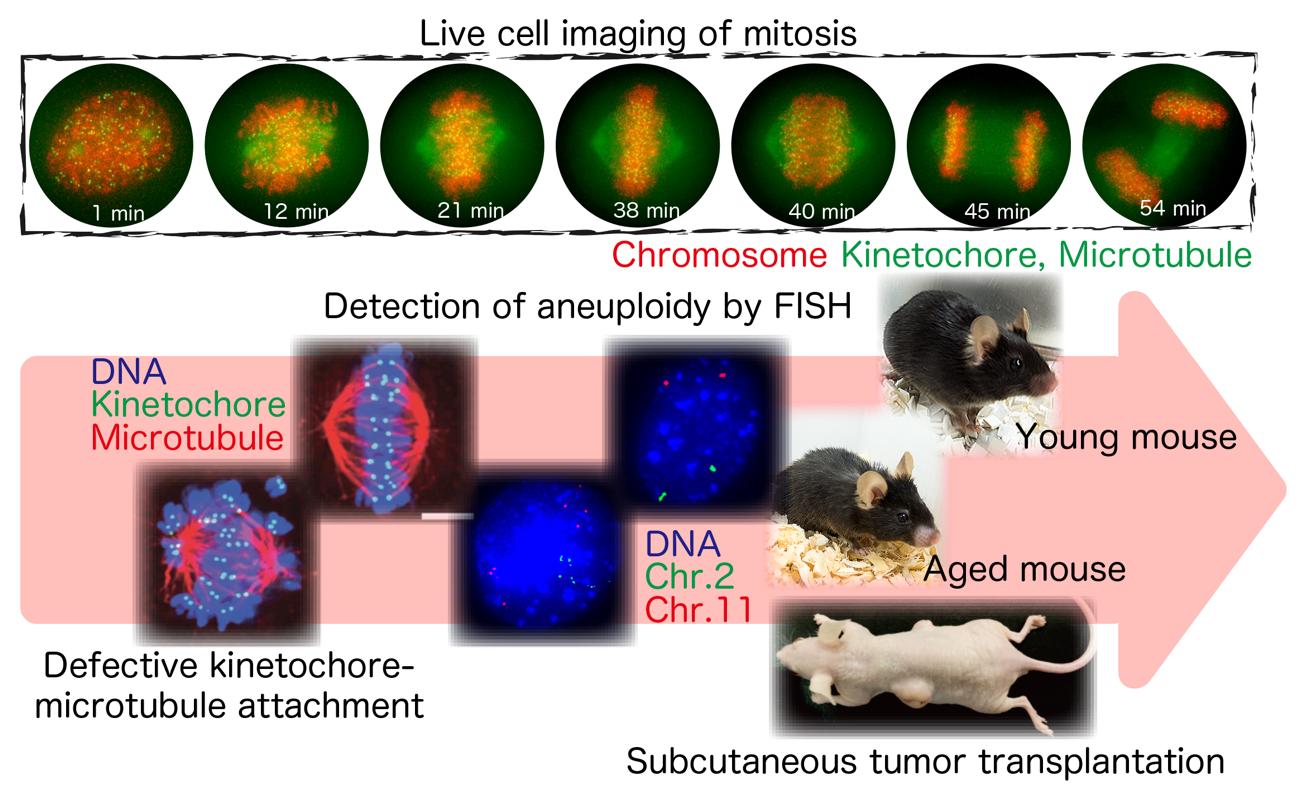
Figure: Research topics in Dept. Molecular Oncology
We study how the genomic instability seen in cancer and aging arises by observing the process of chromosome segregation in cell division.
Research Topics
・Causes of chromosomal instability in cancer cells
・Chromosomal instability associated with aging
・Functional analysis of CHAMP1, a molecule related to intellectual disability
・Relationship of chromosomal instability with cancer and aging
・Development of cancer therapies targeting chromosomal instability
Selected Publications
1. Nagai M et al. Deficiency of CHAMP1, a gene related to intellectual disability, causes impaired neuronal development and a mild behavioral phenotype. Brain Commun (2022) 4, fcac220.
2. Fujita H et al. CHAMP1-POGZ counteracts the inhibitory effect of 53BP1 on homologous recombination and affects PARP inhibitor resistance. Oncogene (2022) 41, 2706-2718.
3. Iemura K et al. Chromosome oscillation promotes Aurora A-dependent Hec1 phosphorylation and mitotic fidelity. J Cell Biol (2021) 220, e202006116.
4. Iemura, K et al. Chromokinesin Kid and kinetochore kinesin CENP-E differentially support chromosome congression without end-on attachment to microtubules. Nat Commun (2015) 6, 6447.
5. Itoh, G et al. CAMP (C13orf8, ZNF828) is a novel regulator of kinetochore-microtubule attachment. EMBO J (2011) 30, 130-144.
Research Interests
cancer, aging, chromosomal instability, genomic instability, chromosome segregation