
| Professor | Natsuko CHIBA |
| Assistant Professor | Zhenzhou FANG |

We conduct research primarily focused on the functional analysis of BRCA1, a gene product responsible for hereditary breast and ovarian cancer (HBOC) syndrome.
Hereditary breast and ovarian cancer (HBOC) is a hereditary cancer syndrome in which germline mutations in BRCA1 and BRCA2 increase the risk of developing breast, ovarian, pancreatic, and prostate cancers. BRCA1 is involved in a wide range of cellular processes; however, our research has particularly focused on its roles in centrosome regulation and homologous recombination repair (Figure 1).
We have identified Obg-like ATPase 1 (OLA1) and Receptor for Activated C Kinase 1 (RACK1) as BRCA1-interacting proteins (Mol Cell 2014; Oncogene 2019), and demonstrated that cancer-associated mutations in these proteins lead to abnormalities in centrosome regulation. Furthermore, we revealed a novel tumor-suppressive function of BRCA1, whereby, following DNA damage, it transmits nuclear DNA damage signals to the centrosome, resulting in an increase in centrosome number (Cancer Sci 2022). We also showed that Aurora A, a mitotic kinase, ubiquitinates OLA1 to promote centrosome maturation (Cell Rep 2023). Based on these findings, we are currently aiming to develop cancer therapies targeting the centrosome.
In addition, we developed a novel method to assess homologous recombination activity, termed the Assay for Site-specific HR Activity (ASHRA) (Sci Rep 2019) (Figure 2). Using this approach, we have elucidated mechanisms of resistance to PARP inhibitors mediated by the transcriptional regulatory function of BRCA1, and we are now working toward applying this method to the diagnosis of HBOC.
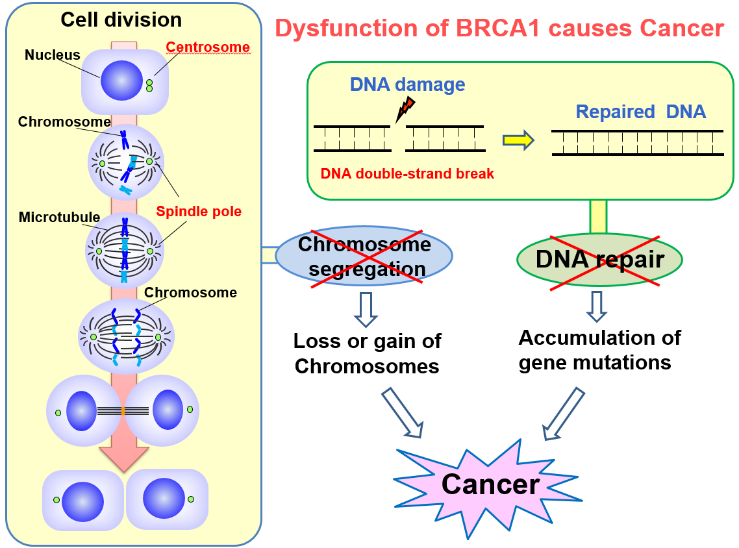
Figure 1 Dysfunction of BRCA1 causes cancer
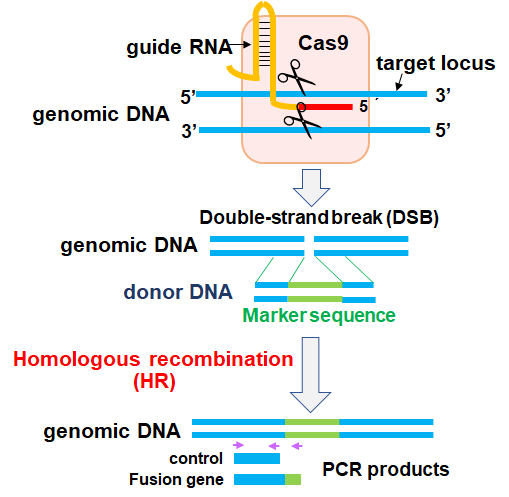
Figure 2 Schematic of ASHRA
Research Topics
・Elucidation of the functions of BRCA1, a causative gene product of hereditary breast and ovarian cancer (HBOC) syndrome.
・Investigation of centrosome regulation mediated by the E3 ubiquitin ligase activity of Aurora A.
・Elucidation of the DNA damage response mechanisms at the centrosome.
・Development of diagnostic methods for HBOC based on the assessment of homologous recombination repair capacity.
・Elucidation of resistance mechanisms to PARP inhibitors mediated by the transcriptional regulatory functions of BRCA1.
Selected Publications
1. Yoshino Y, Fang Z, Chiba N. The centrosome: a critical hub for cell cycle regulation. Trends in Cell Biology, 34(6):437-439, 2024
2. Motonari T, Yoshino Y, Haruta M, Endo S, Sasaki S, Miyashita M, Tada H, Watanabe G, Kaneko T, Ishida T, Chiba N. Evaluating homologous recombination activity in tissues to predict the risk of hereditary breast and ovarian cancer and olaparib sensitivity. Scientific Reports, 14: 7519, 2024
3. Yoshino Y, Ogoh H, Iichi Y, Sasaki T, Yoshida T, Ichimura S, Nakayama M, Wu X, Fujita H, Kikuchi M, Fang Z, Li X, Abe T, Futakuchi M, Nakamura Y, Watanabe T, and Chiba N. Knockout of Brca1-interacting factor Ola1 in female mice induces tumors with estrogen suppressible centrosome amplification. BBA – Molecular Basis of Disease, 1870 (5):167138, 2024
4. Fang Z, Li X, Yoshino Y, Suzuki M, Qi H, Murooka H, Katakai R, Shirota M, Pham T A M, Matsuzawa A, Otsuka K, Ishioka C, Mori T, and Chiba N. Aurora A polyubiquitinates the BRCA1-interacting protein OLA1 to promote centrosome maturation. Cell Reports, 42: 112850, 2023
5. Qi H, Kikuchi M, Yoshino Y, Fang Z, Ohashi K, Gotoh T, Ideta R, Ui A, Endo S, Otsuka K, Shindo N, Gonda K, Ishioka C, Miki Y, Iwabuchi T, and Chiba N. BRCA1 transports the DNA damage signal for CDDP-induced centrosome amplification through the centrosomal Aurora A. Cancer Science, 113(12):4230-4243, 2022
Research Interests
HBOC, BRCA1, Centrosome, Homologous recombination, PARP inhibitor