
| Professor | Fan-Yan WEI |
| Associate Professor (Additional) | Akiko OGAWA |
| Assistant Professor | Shigeru MATSUDA |
| Assistant Professor | Haruna TANI |
| Assistant Professor | RAJA NORARaja Norazireen Raja Ahmad |

Understanding the complexity of life and developing treatments for diseases via RNA modification
Living organisms are made up of a complex array of biomolecules, including proteins, DNA, and RNA, which undergo a variety of chemical modifications in order to acquire new functions and exert control over the higher functions of cells and organs. External chemical, physical, and biological stresses, as well as internal factors, such as genetic variations and aging, can disrupt the state of these modifications, causing the onset of disease and disrupting biological functions. Our research focuses on RNA modifications in particular. By employing state-of-the-art mass spectrometry technology and RNA analysis methodologies, we aim to investigate how RNA modifications regulate physiological functions, such as metabolism and immunity. Additionally, we explore how the dysregulation of RNA modifications contributes to aging-related diseases, such as diabetes and inflammation using cells, animal models, and human subjects as research materials. Notably, the new generation of vaccines that contain chemically modified mRNA has been a driving force in the control of the COVID 19 pandemic. This underscores the essential nature of RNA and its modifications, which are key to understanding the complexity of life, as well as in the development of next-generation medicine. Our team conducts research every day with the hope of contributing to a better understanding of life and the development of new treatments for diseases through RNA and its modifications.
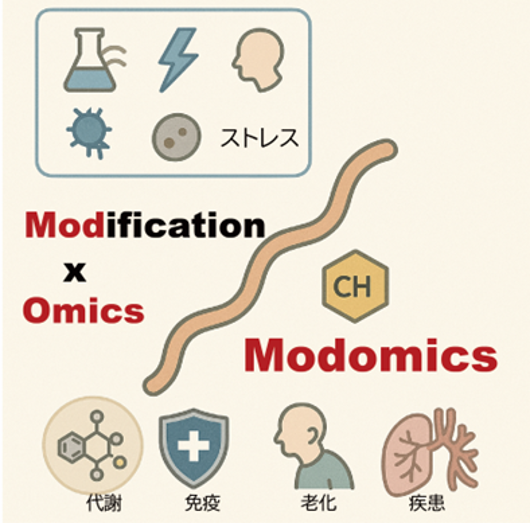
Research Topics
・RNA modification in human physiology and disease
・Mitochondrial biology and disease
Selected Publications
1. A sequential, RNA-derived, modified adenosine pathway safeguards cellular metabolism. Cell. 2025;188(22):6151-6169.e24.
2. Structural insights into the agonist selectivity of the adenosine A3 receptor. Nat Commun. 2024 Nov 7;15(1):9294.
3. N6-methyladenosine (m6A) is an endogenous A3 adenosine receptor ligand. Mol Cell. 2021;81(4):659-674.e7.
4. Loss of Ftsj1 perturbs codon-specific translation efficiency in the brain and is associated with X-linked intellectual disability. Sci Adv. 2021 Mar 26;7(13):eabf3072.
5. Cdk5rap1-mediated 2-methylthio modification of mitochondrial tRNAs governs protein translation and contributes to myopathy in mice and humans. Cell Metab. 2015;21(3):428-442.
Research Interests
RNA modification, Mass spectrometry, mitochondria, nucleic acid metabolism