
| Professor(Specially appointed for research) | Toshiyuki TAKAI |
| Assistant Professor | Rei Yosa |
Drug discovery by elucidation of inhibitory receptor-mediated immune regulation
For the past 25 years, we have consistently analyzed the function of immune regulatory receptors in relation to allergy, autoimmune diseases, and genetic disorders. During this period, we have reported that inadequate function of the inhibitory Fc receptor and the novel inhibitory receptor PIR-B, which we originally discovered, predispose to autoimmune diseases such as systemic lupus erythematosus (SLE). In collaboration with doctors at a university hospital, we also reported that LILRB4, an inhibitory receptor expressed on myeloid cells, is ectopically highly expressed on the surface of pathogenic plasma cells that produce autoantibodies in SLE patients, an unexpected aspect of LILRB4 expression that has pathogenic properties. We were also able to show that such modulation of immune mechanisms may also be involved in bone formation and dementia. Now, we will focus on drug discovery research targeting regulatory receptors as the culmination of our research to overcome cancer, SLE, and neurodegenerative diseases. For example, the concept of “immune checkpoints” has been pointed out as a way to negatively regulate the immune system, weakening the body’s natural immunity against cancer. Based on the simple idea that LILRB4 may also be involved in cancer immunity, we investigated LILRB4 and found that inhibition of LILRB4 clearly enhanced cancer immunity. We also independently discovered that the physiological ligand protein for LILRB4, which had remained a mystery for about 20 years, is the N-terminal 30 kilodalton of fibronectin (FN30). We have applied for a patent in anticipation of the possibility of social implementation of the binding inhibition of FN30 to LILRB4 as an antibody drug for cancer and SLE, and we sincerely hope that we will be able to deliver LILRB4 antibody drugs to cancer patients in the near future.
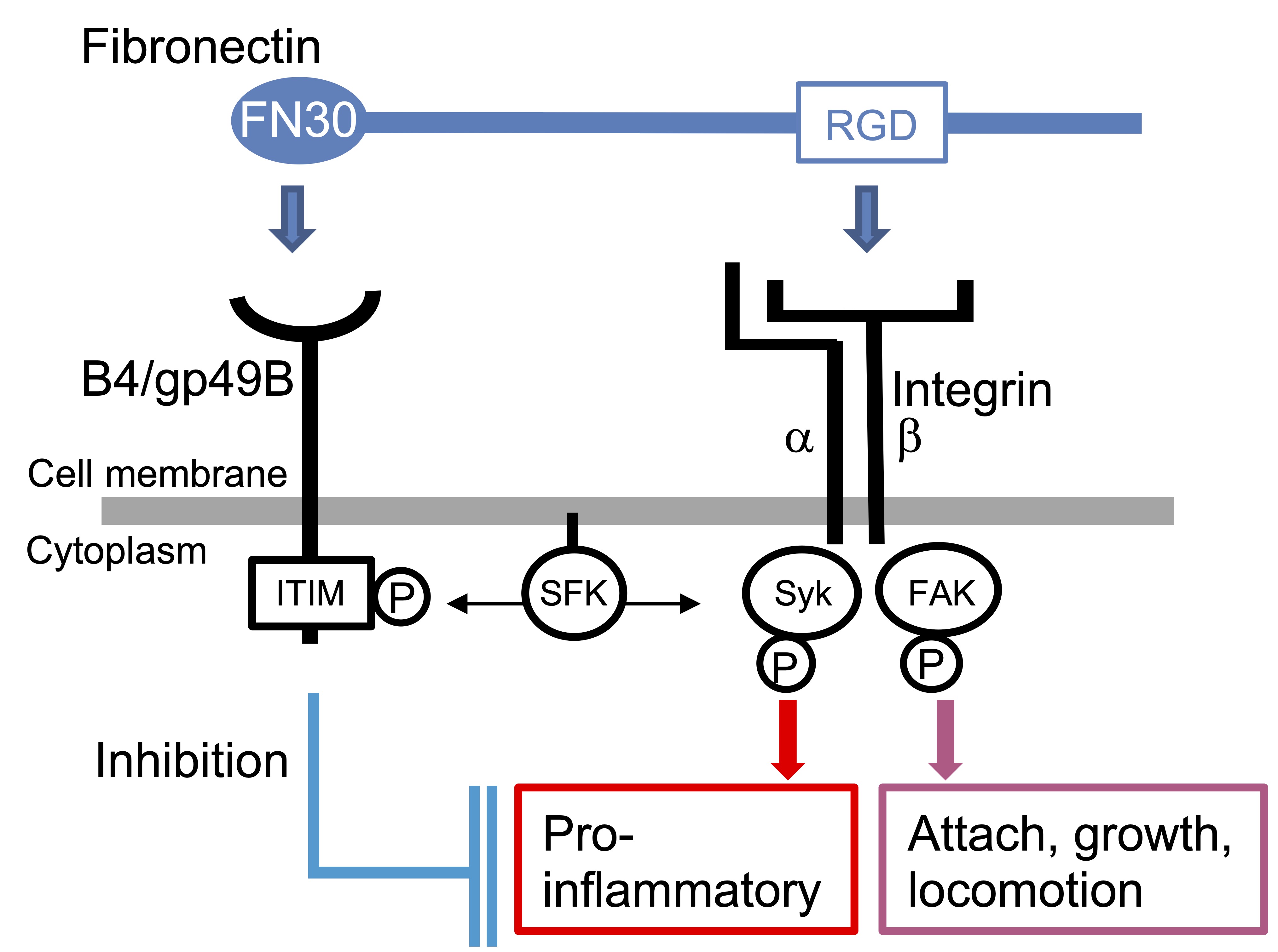
Figure: Immune checkpoint LILRB4 binds fibronectin, an extracellular component, thereby inhibiting integrin activation and proinflammatory signal.
Research Topics
・Identification of novel physiological ligand for LILRB
・Tumor immunity regulated by LILRB on monocytes
・Drug discovery for cancer by blocking immune checkpoint LILRB
Selected Publications
1. Itagaki F et al. Fibronectin on target cells attenuates natural cytotoxicity of NK cells via myeloid immune checkpoint ILT3/LILRB4/gp49B. Int Immu (2023) 35, 339.
2. Itoi S et al. Myeloid immune checkpoint ILT3/LILRB4/gp49B can co-tether fibronectin with integrin on macrophages. Int Immu (2022) 34, 435.
3. Takahashi N et al. Co-localization of fibronectin receptors LILRB4/gp49B and integrin on dendritic cell surface. Tohoku J Exp Med (2022) 257, 171.
4. Su MT et al. LILRB4 promotes tumor metastasis by regulating MDSC-mediated immunosuppression and inhibiting anti-tumor exosomal miRNA secretion. Oncoimmunol (2022) 11, 2060907.
5. Su M-T et al. Blockade of checkpoint ILT3/LILRB4/gp49B binding to fibronectin ameliorates autoimmune disease in BXSB/Yaa mice. Int Immu (2021) 33, 447.
Research Interests
Inhibitory receptor, immune checkpoint, cancer immunotherapy, autoimmune disease, Alzheimer’s disease